
Do I Really Have to Wear Invisalign 22 Hours a Day?
Can skipping a few hours of clear aligner wear really mess up months of orthodontic work? This worry plagues many patients trying to fit treatment into their busy lives.
Invisalign daily wear requirements come from science, not just rules. Studies of over 112,000 patients with dental insurance show that wearing aligners consistently leads to better results. Research on 1.2 million cases proves that biomechanical force application must be steady for teeth to move right.
Studies using the Peer Assessment Rating index back up what orthodontists see every day. Patients who wear aligners less than 20 hours a day often face longer treatment times. This can add weeks or even months to their treatment.
The science behind Invisalign treatment compliance is about changing the periodontal ligament. This process needs constant pressure to move teeth predictably. Knowing this helps explain why 20-22 hours of wear is more than a suggestion—it’s the minimum needed for good results.
Key Takeaways
- Clinical evidence from over 112,000 patients supports the 20-22 hour daily wear recommendation for optimal results
- Wearing clear aligners less than 20 hours daily can delay treatment outcomes by weeks or months
- Continuous biomechanical force application enables controlled periodontal ligament remodeling necessary for tooth movement
- Treatment compliance directly correlates with predictable orthodontic outcomes based on 1.2 million case analyses
- The specific wear time threshold reflects biological requirements, not just conservative estimates
Understanding Invisalign Treatment Duration
Invisalign is a new way to fix teeth without metal braces. It uses special trays that fit over your teeth. This method is based on science to make sure it works well.
What is Invisalign?
Invisalign is a clear aligner system made by Align Technology. It uses special trays to move teeth. These trays are made from a material called SmartTrack, designed for moving teeth smoothly.
This system is different from traditional braces. It uses a series of trays to move teeth into place. The trays are clear, so they’re almost invisible when you wear them.
The success of Invisalign depends on several things. It uses 3D imaging and computer design to make a plan just for you. Most people need 12 to 18 months of treatment for mild to moderate problems.
What makes a case mild to moderate? It depends on things like how crowded your teeth are and how much your teeth overlap.
- Crowding and spacing up to 6mm
- Overjet and overbite up to 6mm
- Predictable treatment timelines when proper protocols are followed
- Documented outcomes as of September 9, 2020
Invisalign trays are different because you can take them out. This makes it easier to eat and brush your teeth. But, it also means you have to wear them for the right amount of time to get good results.
How Does Invisalign Work?
Invisalign works by applying gentle pressure to your teeth. Each tray is designed to push your teeth a little bit. This pressure starts a process in your gums and bones.
When you wear an aligner, your bones react. One part of the bone gets smaller, and another part gets bigger. This is how your teeth move.
This process takes time. Your bones need to keep getting signals from the aligners to move your teeth. Each tray moves your teeth by about 0.25 millimeters.
The trays are worn in a specific order. This order is planned out to make sure your teeth move in the right way.
- Initial force application creates pressure on periodontal ligament
- Cellular signaling activates bone remodeling cells
- Bone resorption occurs in compression zones (3-7 days)
- Bone deposition begins in tension zones (7-14 days)
- Tooth stabilization completes before next aligner (10-14 days)
Wearing Invisalign trays for the right amount of time is important. If you don’t wear them enough, your teeth might not move as planned.
How fast your teeth move depends on a few things. Your age, how dense your bones are, and how bad your teeth are can all affect it. Younger people and those with softer bones tend to see faster results.
Invisalign uses computer simulations to plan your treatment. This helps make sure your teeth will move as planned. It’s all about following the right plan to get the best results.
Following the recommended wear time is key. If you don’t wear your trays as directed, your teeth might not move as expected. This can make your treatment take longer or not work as well.
Importance of Wearing Aligners
Following instructions for Invisalign is key to successful teeth alignment. Teeth move through a biological process that needs constant pressure. This pressure is applied over a long time, not just in short bursts.
Knowing how consistent wear affects treatment results is important. It shows why sticking to the plan is critical. This knowledge helps patients understand the science behind tooth movement and why following guidelines is best.
The Scientific Foundation of 22-Hour Wear
The 22-hour wear rule comes from research on bone and tooth movement. It ensures teeth get constant pressure for most of the day. The two hours off are for eating and cleaning teeth.
Teeth move through bone remodeling. Aligners apply pressure, starting a chain of cell responses. Osteoclasts break down bone, while osteoblasts build new bone.
This process needs constant stimulus to keep moving forward. If aligners are out too long, the process starts over. This resets the movement.
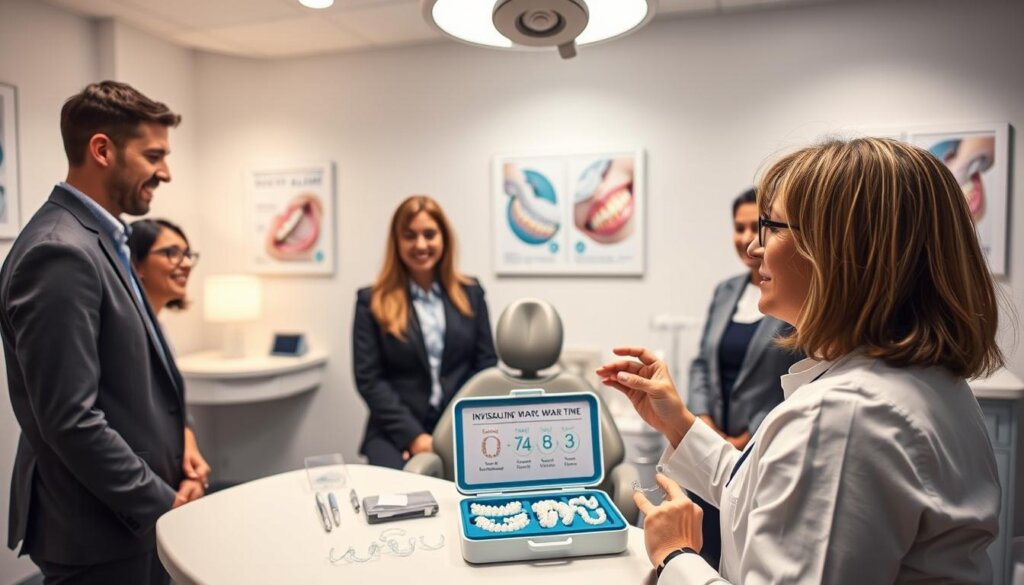
Studies show teeth need constant force to move. The 22-hour rule balances treatment needs with daily life. It allows time for meals, snacks, and cleaning teeth.
The schedule lets for 20-30 minutes for meals and cleaning. This way, patients can eat normally and aligners work well. Orthodontists can predict treatment progress with consistent wear.
Studies show consistent wear leads to on-time treatment. Those who wear aligners for 22 hours a day finish faster. Those who don’t face delays.
Consequences of Inadequate Compliance
Not wearing aligners as recommended affects treatment. Even small reductions in wear time cause delays. The science of tooth movement shows why consistency is key.
Not meeting the 22-hour target slows tooth movement. Teeth move less because of less pressure. Each time aligners are removed, teeth move back a bit, needing more time to move again.
This makes treatment take longer. Patients need more time in each aligner stage. Teeth don’t move as planned, making treatment harder.
Research shows the effects of not wearing aligners:
- Treatment duration extensions: 3-6 months longer for inconsistent wear
- Tracking complications: Aligners don’t fit right when teeth are behind
- Increased discomfort: More pain from pressure and release
- Outcome predictability: Less accurate tooth positions
- Additional aligners: More trays needed for tracking issues
Missing just two hours a day adds up. Over a year, it’s like a month of less movement. This shows the importance of wearing aligners as recommended.
| Compliance Level | Average Daily Wear | Typical Treatment Extension | Tracking Issues |
|---|---|---|---|
| High Compliance | 22+ hours | None (on schedule) | Minimal to none |
| Moderate Compliance | 18-21 hours | 2-4 months added | Occasional fit problems |
| Low Compliance | 14-17 hours | 4-6 months added | Frequent tracking complications |
| Poor Compliance | Under 14 hours | 6+ months or treatment failure | Severe misalignment, refinements needed |
Not wearing aligners as recommended can make treatment longer. It also makes teeth hurt more. Patients feel more pain when they start wearing aligners again.
Orthodontists need treatment to go as planned. Without consistent wear, this is hard. The computer models that make aligners assume patients wear them as planned.
Understanding these consequences helps patients make better choices. The science behind tooth movement shows why following the plan is important. This knowledge helps patients see why sticking to the plan is best for their treatment and looks.
Potential Consequences of Inconsistent Wear
Wearing aligners less than recommended can really mess up orthodontic treatment. It’s not just about delays. It can lead to serious problems that affect how well treatment works. It’s key for patients to stick to the wear schedule they’re given.
Wearing aligners for less time than suggested means treatment doesn’t work as well. Missing hours of wear adds up over time. This can make treatment take longer and affect how well teeth are aligned.
Extended Treatment Time
How long treatment lasts depends on how often you wear aligners. Wearing them for 18 hours a day instead of 22 can slow down treatment by 18%. This can make treatment last 20-30% longer than expected.
Tooth movement needs constant pressure to work. If pressure is not steady, teeth move slower or not at all. This is because bone around teeth needs constant stimulation to move properly.
Even a little less wear each day can add up. Missing just two hours a day for a year means losing 730 hours of treatment. This is why doctors stress the importance of wearing aligners as directed.
Longer treatment times are not just about time. They can also make patients tired of wearing aligners. This can make it harder to keep up with treatment. It also costs more because you might need more aligners and visits to the dentist.
Risks of Misalignment
Not wearing aligners enough can also mess up how teeth line up. Teeth move in three dimensions, so uneven wear can cause some teeth to move more than others. This can lead to problems with how teeth fit together.
These problems can show up in different ways, affecting how well treatment works:
- Rotational discrepancies: Teeth that need to rotate may not move as planned, causing misalignment
- Inadequate space closure: Gaps between teeth may not close up enough because of lack of pressure
- Incomplete leveling: Teeth may not move to the right height, causing vertical alignment issues
- Improper root positioning: Teeth may look straight but roots are not in the right place, affecting stability
These problems might not be obvious while you’re wearing aligners. They can only be seen after treatment is finished. Doctors use X-rays and exams to find these issues, but fixing them can take more time and money.
Fixing these problems can cost more and take longer. You might need new aligners or even switch to traditional braces. This can make treatment more expensive and take longer to finish.
Some problems can affect how well you can chew or even cause jaw pain. These issues might need more treatment, making things even more expensive and time-consuming.
Studies show that wearing aligners as directed leads to better results. Patients who wear them as recommended do better than those who don’t. This is why doctors stress the importance of consistent wear for the best results.
Benefits of Adhering to the Schedule
Following your Invisalign daily wear requirements brings many benefits. These benefits are important for the whole treatment time. Good compliance leads to better results, thanks to how clear aligners work.
The Invisalign wear schedule is like a detailed plan. It helps teeth move in the best way. This makes treatment better in many ways, like how it looks and feels.
Research shows that good compliance makes a big difference. It affects how well treatment works and how easy it is. This is because of how our teeth and mouths work.
Achieving Superior Treatment Outcomes
Wearing aligners as planned helps finish treatment on time. This is because teeth move smoothly without any stops. Invisalign treatment effectiveness is best when everything works together.
Aligners move teeth in a special way. This needs all teeth to move together. Wearing them as planned makes this happen well.
- Reduced need for mid-treatment adjustments: Teeth move as planned without extra changes
- Optimal intercuspation: Teeth fit together well for long-term stability
- Minimized post-treatment refinements: Fewer extra aligners needed after treatment
- Enhanced treatment precision: Teeth end up in the right places
Studies show that good compliance also means better looks. The small details of tooth movement are important. When patients wear aligners as they should, doctors can see how treatment is going.
Stable results also depend on good compliance. Teeth move smoothly and stay in place better. This is because of how our bodies adapt to change.
Experiencing Enhanced Comfort Throughout Treatment
Wearing aligners as planned can actually make them feel more comfortable. This might seem strange, but it’s true. Teeth get used to moving slowly over time.
The gums get used to the movement too. But if you take out the aligners for too long, they have to start over. This can make them feel tight again.
Patients who wear aligners well find they get used to new ones faster. This is because teeth are always moving in the right direction. Each new aligner is just a small step.
Wearing them as planned also means they fit better. If teeth move too slow, aligners don’t fit right. This can cause discomfort in many ways.
- Pressure points: Aligners put too much pressure on some teeth
- Edge lifting: Gaps can irritate the gums
- General tightness: Aligners feel tight all the time
- Speech interference: Poor fit can make speaking hard
Good compliance means better treatment and comfort. This makes wearing aligners easier as treatment goes on. It’s a positive cycle.
Exceptions to the 22-Hour Rule
The 22-hour rule has some flexibility for important activities and occasional exceptions. These exceptions help patients keep their treatment effective while dealing with daily life. The two-hour break from aligners is for specific needs that orthodontic rules allow.
Doctors set Invisalign wear time guidelines knowing strict rules are hard to follow. They balance the need for aligners to be on most of the time with breaks for daily activities. This balance is based on evidence, not just rules.
Knowing when to take off aligners is key for patients. It helps them make choices that support their treatment goals. Staying close to the 22-hour rule requires planning around daily activities.
Necessary Aligner Removal for Meals and Beverages
Orthodontic rules say remove Invisalign aligners for eating and drinking anything but water. This keeps teeth and aligners clean and healthy. Food trapped in aligners can lead to cavities and tooth damage.
Drinks like coffee and red wine can stain aligners, making them less clear. Acidic drinks can also damage the aligners, making them less effective. This can slow down tooth movement.
Sugar drinks are the biggest risk with aligners in. They trap sugar against teeth, leading to cavities quickly. This is a big problem during orthodontic treatment.
Planning meals helps patients wear aligners more often. They can eat three meals and brush and floss in the two-hour break. Keeping meals short helps avoid too much time without aligners.
Here are some tips for managing meals and aligners:
- Consolidate eating periods by planning regular meal times
- Prepare oral hygiene supplies in advance
- Choose efficient cleaning methods like pre-pasted toothbrushes
- Plan beverage consumption during meals
- Carry water bottles to stay hydrated without removing aligners
Good oral hygiene is key to not removing aligners too often. Brush and floss well after meals, but do it quickly. This helps keep teeth and aligners healthy without wasting time.
Discretionary Removal for Social and Professional Situations
Removing aligners for special occasions is okay, but not always necessary. It’s about balancing treatment needs with life’s moments. A little flexibility is okay, but not too much.
It’s important to know the difference between special occasions and regular habits. Removing aligners for every social event is not the same as doing it for a wedding. The goal is to keep aligners on most of the time.
Patients should think about the reasons for removing aligners. Is it for a special event or just a regular dinner? Staying consistent is better for treatment success.
Short breaks for photos or quick meetings are usually fine. But, taking aligners off for hours can slow down treatment. It’s better to wear them as much as possible.
Missing the 22-hour goal sometimes is okay, but not often. If you miss it one day, try to make up for it the next. This keeps treatment on track.
But, don’t make a habit of it. Trying to make up for lost time can mess up treatment. The goal is to stick to the 22-hour rule as much as possible.
Even small breaks can add up over time. If you remove aligners for snacks or drinks, it can slow down treatment. Being aware of this helps keep treatment on track.
Patients who plan for exceptions and stick to the rule do well. It’s about being consistent most of the time. This approach works best for treatment success.
Age and Compliance
How well a patient follows the Invisalign wear schedule depends a lot on their age. Studies show that younger people might not be as good at sticking to a routine. This is because their brains are not fully developed yet.
Age affects how well someone can follow the Invisalign daily wear requirements. It’s not just about being responsible. It’s also about how the brain works and how someone makes decisions. Knowing this helps doctors and patients come up with plans that work for each person.
How Age Affects Responsibility
The part of the brain that helps with planning and thinking ahead keeps growing until the mid-twenties. This means younger people might find it harder to manage their treatment on their own. They might not always think about the long-term benefits of wearing Invisalign.
Younger teens, between 12 and 14, really need help from their parents to stay on track with Invisalign treatment compliance. They do well with reminders and tracking systems. Without these, they might find it hard to keep up with their treatment.
Teens between 15 and 17 are getting more independent but can use some guidance. They understand why they need to wear Invisalign but might choose to take it off when they’re with friends. They’re caught between wanting to fit in and following their treatment plan.
Young adults, on the other hand, are more likely to take care of themselves. But they face challenges like school and work. They know how important it is to follow their Invisalign wear schedule, but it can be hard to keep up with their busy lives.
It’s important to remember that how well someone follows their treatment plan changes as they get older. Doctors know this and adjust how they talk to patients. Younger patients need clear, simple reminders, while older ones might respond better to talking about the long-term benefits.
Teen Personalities and Invisalign
How well a teen does with Invisalign also depends on their personality. Being organized and responsible helps a lot. Teens who are more organized tend to wear their aligners more consistently.
Believing in one’s ability to do something is also key. Teens who think they can handle their treatment do better. Giving them positive feedback early on helps them stay on track.
Some teens think more about the present than the future. This can make it harder for them to stick to their Invisalign wear schedule. But, if they can see how their daily actions affect their future, they might do better.
Friends can be a big influence on teens. Some teens might be more motivated to wear their aligners because they want a better smile. But, they might also take them out when they’re with friends.
There are ways to help teens stick to their treatment plan, no matter their personality:
- Compliance indicators in some aligners give feedback on wear time
- Behavioral contracts set clear expectations between patients, parents, and orthodontists
- Positive reinforcement systems celebrate achievements, not failures
- Smartphone applications send reminders and track progress
- Peer support groups make treatment seem normal and reduce anxiety
Parents play a big role in helping teens stick to their treatment plan. It’s important to work together without making the teen feel controlled. Talking about progress in a positive way helps keep them motivated.
| Age Group | Compliance Challenges | Effective Support Strategies | Typical Success Factors |
|---|---|---|---|
| 12-14 Years | Limited executive function, forgetfulness, requires external motivation | Parental reminders, visual tracking charts, immediate rewards | Strong parental involvement, structured routines, frequent positive feedback |
| 15-17 Years | Social self-consciousness, peer pressure, balancing multiple responsibilities | Privacy-respecting check-ins, peer support, smartphone apps | Personal motivation for appearance, increasing autonomy with accountability |
| 18-25 Years | Competing lifestyle demands, complex schedules, reduced oversight | Self-monitoring tools, professional goal-setting, outcome visualization | Intrinsic motivation, long-term thinking, personal investment in results |
| Adult (26+) | Work obligations, family responsibilities, established habits | Integration into daily routines, professional consequences awareness | High conscientiousness, commitment to investment, understanding of opportunity cost |
Understanding how personality and age affect Invisalign treatment helps doctors plan better. By knowing these differences, doctors can offer the right amount of help and support. This approach makes it more likely that patients will stick to their treatment plan.
The connection between age, personality, and following treatment plans shows how complex orthodontic care can be. By considering these factors, doctors and patients can work together to find ways to make treatment successful. This approach respects the patient’s age and personality while helping them achieve their goals.
The Role of Compliance Indicators
Monitoring how well patients follow Invisalign wear time guidelines is a big challenge. Unlike traditional braces, Invisalign aligners need patients to wear them correctly for success. This makes it hard for orthodontists to know if patients are wearing them enough.
To solve this problem, new technology was developed. This technology helps orthodontists and patients understand how well the treatment is working.
Understanding Built-In Monitoring Technology
Compliance indicators are small markers in some Invisalign aligners that show how long they’ve been worn. They are usually a blue dot on the aligner’s surface, near the molars.
This technology works by changing color when it gets wet. The blue dot fades to clear or white over time. It fades at a rate that matches the recommended wear time.
This simple solution gives clear evidence of how often aligners are worn. It doesn’t need complicated electronics or for patients to report their wear time. The dyes in the indicators change color when they get wet, showing how long they’ve been in the mouth.
- They show cumulative wear time, not daily wear patterns. So, a patient could wear them more on some days to make up for missing hours on others.
- They can’t tell if the aligners were worn continuously or in short periods that add up to the same total hours.
- How fast the indicator fades can be affected by how much saliva a person has and their oral environment.
- They only show how much the aligners have been worn after the fact, not while they’re being worn.
Even with these limits, compliance indicators are a big step forward in orthodontic care. They turn invisible behavior into visible data that helps make treatment decisions.
Clinical Applications and Treatment Impact
Orthodontists use compliance indicator data during check-ups. They look at how well the treatment is working and if the teeth are moving as planned.
The indicator reading adds an objective part to this evaluation. If the indicator is fully faded and the teeth are moving as planned, the treatment is on track. But, if the indicator is blue and the teeth aren’t moving enough, it might mean the aligners aren’t being worn enough.
If the indicator shows the patient isn’t wearing the aligners enough, the orthodontist will talk about it in a helpful way. They’ll work together to find ways to make wearing the aligners easier and more consistent.
- They might talk about how the patient’s lifestyle affects wearing the aligners for 22 hours a day.
- They might help with any comfort issues that make it hard to wear the aligners all the time.
- They’ll remind the patient how important it is to wear the aligners to get the best results.
- If needed, they might change how long the patient wears certain aligners before moving to the next set.
For young patients, compliance indicators can help them see how their actions affect their treatment. This tangible connection between what they do and how their teeth move can motivate them more than just telling them to wear the aligners.
These indicators also help make treatment decisions. If a patient isn’t wearing the aligners enough, the orthodontist might make the treatment longer. This gives the teeth more time to move into the right position.
In cases where a patient just can’t wear the aligners enough, the treatment plan might need to change. This could mean adding more steps to the treatment or using different ways to keep the teeth in place after the treatment is done. These changes help make sure the treatment works, even if the patient can’t wear the aligners as much as they should.
Compliance indicators help show how well a patient is doing over time. They help orthodontists know who might need more help or who might need a different treatment plan. This makes treatment better for everyone involved.
These tools make it clear if a patient is following the treatment plan. They turn invisible behavior into something that can be seen and talked about. This makes treatment more effective and helps patients and orthodontists work together better.
Tips for Staying on Track
Switching from knowing about compliance theory to actually using it is all about strategies and tools. Patients know they need to wear their Invisalign daily, but making it a habit is hard. Behavioral science shows that reminders and changes in the environment help a lot, at least in the beginning.
To stay on track, it’s important to have support. This means making it easy to wear Invisalign without it feeling like a chore. Simple reminders and big plans can help with the daily challenges of wearing aligners.
Establishing Effective Reminder Systems
Just remembering to wear Invisalign isn’t enough. Even the most motivated people forget sometimes. Setting alarms on your phone for meal times helps a lot.
There are apps made just for Invisalign that do more than just remind you. They track how long you wear them, show how your treatment is going, and alert you at the right times. Seeing how you’re doing helps you stay on track.
Putting reminders in places you visit often helps too. Notes on mirrors, tables, and desks make it easier to remember to wear Invisalign. This is really helpful when you’re just starting out.
Linking wearing Invisalign to things you already do makes it easier. For example, if you always brush your teeth after eating, you can do the same with Invisalign. This makes it a natural part of your routine.
- Smartphone alarms: Set recurring alerts for 30 minutes after typical meal times to prompt aligner reinsertion
- Tracking applications: Use specialized Invisalign apps that monitor wear time and provide progress visualization
- Visual cues: Place physical reminders in high-traffic areas like bathrooms, bedrooms, and workspaces
- Habit stacking: Connect aligner reinsertion to existing routines such as post-meal tooth brushing
- Travel preparation: Create dedicated kits with cases and cleaning supplies to prevent forgetting aligners when away from home
Regular visits to the orthodontist help too. They check how you’re doing and help you stay on track. This makes sure you’re wearing Invisalign as much as you should.
Maintaining Aligner Cleanliness for Compliance Motivation
Cleaning your aligners is important for both health and motivation. Clean aligners are easier to wear than dirty ones. This makes it easier to remember to put them back in.
Use a soft brush and clear soap to clean your aligners. This removes food and plaque without damaging them. Rinsing with cool water is the final step after every meal.
Deep cleaning is also important. Special solutions and ultrasonic cleaners can get rid of tough stains and bacteria. This keeps your aligners looking and feeling good.
| Cleaning Method | Frequency | Benefits | Cautions |
|---|---|---|---|
| Soft brush with clear soap | Every removal | Removes surface debris and prevents buildup | Avoid abrasive toothpastes that scratch surfaces |
| Cool water rinse | Every removal and insertion | Quick freshening between cleanings | Never use hot water that warps thermoplastic |
| Specialized cleaning solution soak | Daily or every other day | Deep sanitization and odor elimination | Follow manufacturer timing recommendations |
| Ultrasonic cleaner | Weekly | Professional-level cleaning of microscopic particles | Use only devices designed for dental appliances |
Using hot water or the wrong toothpaste can damage your aligners. This makes them less effective and harder to wear. Always use cool water and gentle cleaners.
Colored or scented soaps can stain your aligners. Use clear, unscented soap instead. Keeping your aligners clean makes you more likely to wear them.
Always carry your aligner case with you. This prevents losing or damaging your aligners. Cases keep them safe and clean while you eat.
Brushing your teeth after meals helps in more ways than one. It makes your mouth feel fresh and reminds you to put in your aligners. This makes it easier to remember to wear them.
How to Handle “Cheating” on Wear Time
Admitting to not wearing Invisalign as much as you should is the first step to keeping your treatment on track. Almost everyone has times when they can’t wear it for 22 hours, like during social events or when they’re sick. Instead of feeling like you’ve failed, knowing how to fix the problem helps you stay on course.
How you handle not wearing Invisalign enough depends on how often it happens and for how long. We know that small mistakes need different fixes than big ones. Being honest about your wear time helps you get better results than trying to ignore the issue.
What to Do If You Miss Hours
If you realize you haven’t worn your Invisalign for as long as you should, put it back on right away. Teeth move best when they’re pushed gently and consistently. Even a little break can slow down the movement.
For small mistakes, like wearing it for 18-20 hours instead of 22, just get back on track right away. These small mistakes usually don’t cause big problems if they don’t happen often.
We have a plan for dealing with different levels of not wearing Invisalign enough:
- Minimal deviation (1-2 hours missed): Just get back to wearing it as much as you should; usually, no changes needed
- Moderate lapse (4-6 hours missed or 18-20 hours worn): Wear it as much as you should again and watch how it fits for the next 48 hours
- Significant gap (full day with less than 18 hours): Wear the current aligner for 1-2 more days before moving on
- Major non-compliance (24+ hours without aligners): Talk to your orthodontist before moving on; might need to go back to a previous aligner
Don’t move on to the next aligner if you haven’t worn the current one enough. Trying to catch up can cause problems with how well the aligners fit. This can make treatment take longer than it should.
Some people wonder if they can make up for lost time by wearing their aligners more the next day. While wearing them a bit longer can help, it’s better to prevent problems than fix them. The way teeth move in response to orthodontic treatment has its own timeline that can’t be rushed.
Following the Invisalign wear time guidelines consistently leads to better results than wearing them too little or too much. The gums and bones respond best to steady, consistent pressure, not on and off.
Communicating with Your Orthodontist
Talking openly with your orthodontist about any issues with wearing Invisalign is key to success. Many people are afraid to talk about their problems because they’re worried about being judged. But hiding it can lead to bigger problems than facing them head-on.
The relationship between you and your orthodontist should be a partnership where you both work together. They’ve seen every kind of problem and want to help you succeed, not criticize you.
When you talk about your problems, give specific details like:
- How often you have trouble wearing it (is it a one-time thing or a regular problem?)
- How long you miss wearing it (hours per time)
- What makes it hard for you to wear it (work, social events, forgetfulness)
- What’s holding you back (discomfort, lifestyle, motivation)
This information helps your orthodontist come up with a plan just for you. They might adjust how often you get new aligners, give you tools to help you remember, or find ways to make treatment easier for you.
Regular check-ins help keep you on track and give you a chance to talk about any problems before they get worse. Patients who are open from the start usually do better than those who hide their issues.
Your orthodontist needs to know how well you’re wearing your aligners to make the right decisions. What seems like a small problem to you might need a big change in your treatment. On the other hand, what you think is a big problem might not need much fixing at all.
By facing your challenges wisely and taking action, you can make the most of your orthodontic treatment. The key is to recognize problems quickly, take the right steps to fix them, and talk openly with your orthodontist.
Alternatives to Traditional Invisalign Compliance
The orthodontic world has come up with new ways to help patients. These options are different from the usual Invisalign rules. They know that not everyone can follow the 22-hour rule.
Now, there are many clear aligner systems out there. They use different materials and have their own rules for wear. This means there’s something for everyone, no matter what they need.
Research is always looking into how these new options work. They want to know if they’re as good as traditional Invisalign.
Nighttime-Only Solutions
Some systems are made for people who can’t wear Invisalign all day. They need to wear it only at night, for 8-10 hours. This is a big change from the usual 22 hours.
There are two main ways these nighttime systems work. One uses strong forces for a short time to move teeth. The other uses gentle forces all night long.
Studies are starting to show how these nighttime systems work. They seem to work well for some cases, but not all. They might not be as good for very complex problems.
Nighttime-only systems are a middle ground. They work for some people, but you have to wear them every night without fail.
Who can use these systems depends on their case. They’re not for everyone, like those with very crowded teeth or big tooth rotations.
- Severe crowding requiring substantial space creation
- Significant tooth rotations exceeding 20 degrees
- Cases requiring substantial vertical corrections
- Complex anteroposterior relationship adjustments
- Patients with poor compliance history
It’s very important to wear these systems every night. Missing one night can really slow down progress. Treatment can take 18-24 months or more.
Other Clear Aligners
There are many clear aligner systems out there, not just Invisalign. Each one has its own materials and ways of working. Knowing about these differences helps choose the right one.
Material science is a big difference between systems. Align Technology’s SmartTrack material is special. It’s different from other materials in how it works and feels.
| Aligner System Feature | Traditional Invisalign | Alternative Clear Aligners | Direct-to-Consumer Systems |
|---|---|---|---|
| Material Technology | SmartTrack proprietary material with consistent force delivery | Various thermoplastics with different elastic properties | Standard thermoplastic materials with basic performance |
| Treatment Planning Software | ClinCheck Pro with extensive 3D simulation capabilities | Varies from sophisticated to simplified planning tools | Basic digital planning with limited customization |
| Professional Oversight | Continuous orthodontist monitoring with regular adjustments | Professional supervision with varying frequency levels | Minimal to no in-person professional monitoring |
| Cost Range | $3,000-$8,000 depending on case complexity | $2,000-$6,000 with variable payment options | $1,500-$2,500 with remote monitoring only |
Treatment planning software is a big difference between systems. Some systems have very advanced 3D tools. Others are simpler for small fixes.
Direct-to-consumer systems are cheaper but have less professional help. They don’t need office visits. But, they can’t always fix problems as well.
Choosing a system needs careful thought. Ask your dentist about their experience and training. Think about the system’s success rate and if it fits your case.
When looking at costs, think about the whole treatment, not just the price. The cheapest option might not be the best value. Getting professional advice is key to making the right choice.
Evaluating Your Invisalign Experience
Being active in your Invisalign treatment helps you see improvements and stay motivated. Taking charge of your orthodontic journey makes you more involved. It shows how your daily actions affect your results. Regular checks between visits help spot issues early and celebrate your smile’s changes.
Knowing how well Invisalign treatment effectiveness works needs you to pay attention. Patients who watch their progress closely are happier and stick to their treatment plan better. This teamwork between you and your orthodontist leads to better results.
Conducting Regular Self-Checks Between Appointments
Setting up a routine for checking yourself helps catch small changes. Weekly checks give you important information about your treatment’s progress. These quick checks are worth it for long-term success.
Your aligners should fit right, without gaps at the edges or biting surfaces. When you put in a new aligner, you might feel some pressure that gets less over time. Following Invisalign wear time guidelines helps this process work as planned.
Pain that lasts or gets worse with new aligners might mean you need to see your orthodontist. Normal feelings include some pressure and a bit of tenderness when chewing. But sharp pain or trouble getting an aligner in place means your teeth might not be moving right.
Here are some self-check practices to try during your treatment:
- Visual inspection: Look for gaps between your aligners and teeth, mainly at the gumline and biting edges
- Pressure evaluation: Notice if new aligners start with the right pressure that goes down over a few days
- Compliance tracking: Keep a log of how many hours a day you wear your aligners and any times you take them out
- Photography documentation: Take weekly photos from the same spot and lighting
- Advancement timing: See if you can move to new aligners on time without forcing them
Spotting issues early lets you fix them before they get worse. Many Invisalign treatment compliance problems can be solved quickly. Waiting too long can turn small issues into big problems that need more treatment.
Signs you should call your orthodontist include aligners that won’t fit right, teeth that seem stuck, or trouble moving to new aligners. These signs mean your teeth might not be moving as planned.
Watching your progress has mental benefits too. People who check their own progress often feel more in control. This feeling helps reduce anxiety and keeps you motivated.
Orthodontists use special checks during visits to see how you’re doing. They look at how your teeth are moving and if everything is working right. They check if space is being made and if attachments are staying in place.
Documenting and Celebrating Progressive Changes
Teeth move slowly, so it’s hard to see changes every day. Making progress visible helps keep you motivated. Seeing small improvements reminds you of the importance of following Invisalign wear time guidelines.
Photography is the best way to show how your smile is changing over time. Take photos every month in the same way. This lets you see how far you’ve come.
Look at your progress by comparing photos from the start. Seeing how far you’ve come helps you stay excited about your treatment. It’s more meaningful to compare month to month than week to week.
Focus on specific signs of progress during your treatment:
- Midline alignment: The center line between your front teeth should get closer to your facial midline
- Crowding reduction: Teeth that were overlapping start to separate as space is made
- Spacing closure: Gaps between teeth get smaller as alignment improves
- Smile arc improvement: The curve of your upper teeth becomes more even and attractive
- Bite relationship: Upper and lower teeth fit together better in proper occlusion
Seeing your progress has many benefits. It motivates you to keep up with your treatment, even when it’s hard. Knowing you’re on the right path makes you feel good and keeps you going.
Understanding your treatment journey makes you more involved in your care. This active role improves your treatment results and satisfaction. Feeling in control of your progress boosts your motivation throughout your treatment.
Conclusion: Making Invisalign Work for You
The question “Do I really have to wear Invisalign 22 hours a day?” has a clear answer. Research shows that Invisalign works best when you wear it as directed. If you wear it consistently, you can get similar results to traditional braces.
But, if you don’t wear it enough, your treatment will take longer. This can also affect how well it works.
Prioritizing Your Dental Health
Orthodontic treatment is more than just making your teeth look good. It also improves how your teeth work together and can help prevent gum disease. Seeing Invisalign treatment compliance as a health choice makes it easier to stick to it.
The small daily effort of wearing aligners leads to big, lasting changes. Your teeth will work better and look better too.
Staying Committed to Your Smile Goals
Staying motivated is key during treatment. You’ll go through different feelings, from excitement to a middle phase that’s tough. But, as you get closer to the end, you’ll feel more energized again.
Ways to stay on track include looking at before photos, celebrating small wins, and joining online groups. Remember, wearing aligners for 22 hours a day is based on science, not just rules. With commitment and regular wear, you can get the smile you want. Success comes from understanding the importance of following through and believing in yourself.

