
How Long Does Invisalign Treatment Usually Take?
Imagine getting a confident smile in less time than you think. Many people considering Invisalign wonder how long it takes. Each case is different, with its own challenges and chances for success.
The Invisalign treatment duration can be from 3 to 18 months. Simple fixes might need just 6 months, while complex cases could take longer than 18 months. Invisalign is often faster than metal braces, finishing up to 50% quicker.
The orthodontic treatment timeframe depends on several things. These include how bad the tooth misalignment is, how well you wear the aligners, and how your body responds to the treatment. Knowing these factors helps you understand what to expect and make better choices for your smile.
Key Takeaways
- Average clear aligner therapy duration spans 12 to 18 months for most patients seeking complete dental correction
- Minor orthodontic adjustments can be completed in as little as 6 months, providing quick aesthetic improvements
- Complex cases involving significant tooth movement may require 18 months or longer for the best results
- Clear aligner systems work up to 50% faster than traditional metal braces for similar cases
- Individual factors such as compliance with wearing aligners 20-22 hours daily significantly impact timeline outcomes
- The specific orthodontic issues being addressed—including rotation, spacing, or bite correction—directly influence duration
Understanding Invisalign Treatment Duration
Before we dive into how long Invisalign takes, let’s understand how it works. Clear aligner systems are different from traditional braces. The average time for Invisalign changes based on each person’s needs. Knowing how the technology works helps set realistic expectations.
The Invisalign timeline is shaped by advanced engineering and biology. These work together to move teeth into their new positions.
What is Invisalign?
Invisalign is a big step forward in dental correction. It uses computer design and special materials to make custom aligners. These aligners are clear and fit well with today’s lifestyle.
These aligners are made from a special material called SmartTrack. It’s designed for orthodontics, providing the right amount of force. Each aligner is made to move teeth in a specific way, moving patients closer to their goal.
The Invisalign timeline starts with taking digital impressions of your teeth. Advanced software then creates a 3D plan for your treatment. This plan helps orthodontists predict how long treatment will take and make any needed changes.
How Does Invisalign Work?
To understand clear aligner system mechanics, we need to look at how teeth move. Invisalign uses force to change tooth positions. This force triggers bone changes in the jaw.
Each aligner applies specific forces to move teeth. This process, called orthodontic tooth movement, happens through bone changes. The aligner’s pressure causes bone to be broken down and rebuilt, moving teeth.
The SmartTrack material is key to Invisalign’s success. It delivers consistent force for two weeks at a time. This ensures steady progress without discomfort.
Changing aligners builds on previous movements. This careful approach respects the body’s limits. It balances safety and efficiency in treatment.
| Treatment Aspect | Traditional Braces | Invisalign System | Clinical Advantage |
|---|---|---|---|
| Force Application | Continuous fixed pressure | Controlled removable pressure | Reduced soft tissue irritation |
| Adjustment Mechanism | Manual wire tightening | Pre-programmed aligner sequence | Predictable tooth movement |
| Material Technology | Metal alloys and brackets | SmartTrack thermoplastic | Enhanced comfort and fit |
| Treatment Planning | Progressive manual adjustments | Digital 3D simulation | Accurate duration forecasting |
The precision of clear aligner system mechanics lets orthodontists control tooth movement. They plan the sequence and timing of movements. This ensures the best results in the shortest time.
Attachments are small, tooth-colored buttons that help with complex movements. They allow the aligners to grip teeth better, making rotations and vertical movements possible. This shows how modern orthodontics combines with new materials to improve treatment.
Understanding Invisalign technology and how it works helps explain why treatment times vary. The body’s limits and the precision of aligner engineering set the stage for orthodontic correction.
Average Duration of Treatment
When patients ask about treatment time, orthodontists look at many factors. The teeth straightening timeframe is a common question. Knowing what to expect helps patients feel more confident and clear about the process.
Research shows that outcomes vary based on many factors. What affects your treatment time? It depends on both general trends and your personal situation.
Standard Treatment Timelines
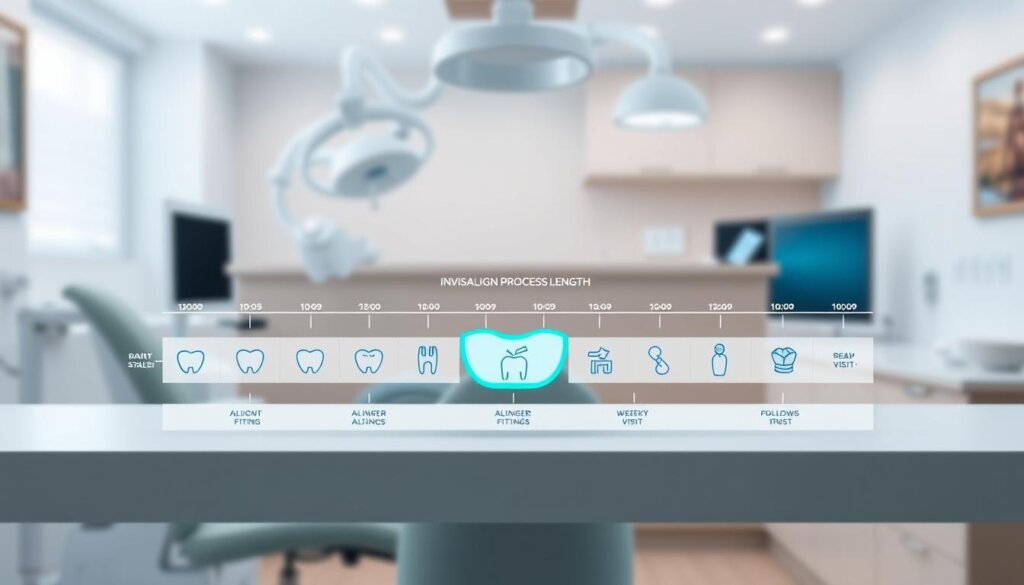
The Invisalign treatment process length usually lasts from twelve to eighteen months. This is for those needing to move teeth a lot. Studies show this is the most common time frame.
But, some cases are simpler. For example, small changes to the front teeth might take six months or less. This is for minor issues like a bit of crowding or small tooth rotations.
On the other hand, more complex cases can take longer. This includes severe problems like big gaps or bad bites. These cases might need up to twenty-four months or more.
The Invisalign system has different levels for different needs. Each level has a specific typical orthodontic duration based on how many aligners you need and the type of corrections.
| Treatment Type | Duration Range | Number of Aligners | Best Suited For |
|---|---|---|---|
| Invisalign Express | 3-6 months | Up to 7 aligners | Minor cosmetic adjustments, limited anterior correction |
| Invisalign Lite | 6-12 months | Up to 14 aligners | Mild to moderate crowding, minor bite issues |
| Invisalign Full | 12-18 months | Unlimited aligners | Comprehensive correction, complex malocclusion |
| Complex Cases | 18-24+ months | Extended series | Severe crowding, significant bite correction, multiple refinements |
Variables That Determine Treatment Duration
A detailed treatment variables analysis shows that many factors affect treatment time. Why do two patients with similar conditions have different treatment times? It’s because of many factors that orthodontists consider when planning treatment.
Patient-specific biological factors are very important. Age and bone density affect how fast teeth move. The health of the gums also plays a big role in how teeth can be moved safely.
Genetics and overall health also influence how quickly teeth move. Patients with good bone health and a strong immune system might move through treatment faster.
Treatment-specific variables include:
- Magnitude of tooth movements: Moving teeth a long way takes more time and aligners
- Number of teeth requiring repositioning: Moving more teeth takes longer than just a few
- Direction of movements: Moving teeth up or rotating them takes longer than just moving them slightly
- Presence of skeletal discrepancies: Jaw problems may need extra steps
- Extraction spaces: Closing gaps from missing teeth takes more time
How well you follow the treatment plan is a big factor. Wearing aligners for the full twenty-two hours a day helps you stay on track. Not wearing them enough can make treatment take longer, sometimes by months.
Mid-treatment changes are sometimes needed. About forty percent of Invisalign cases need a second phase to get the best results. This adds two to six months to the original typical orthodontic duration estimate. These changes help make sure the treatment is perfect, not a failure.
Complications like poor tracking or unexpected responses can also affect treatment time. Catching these problems early helps avoid longer treatment times.
Understanding all these factors helps orthodontists give accurate estimates during consultations. Patients get a clear idea of what to expect, based on both general trends and their own situation. This helps them make informed decisions and stay committed to their treatment.
Early Stages of Invisalign Treatment
The early stages of Invisalign treatment are key to its success. Before starting, patients go through detailed diagnostic tests. These tests help create a treatment plan just for them. This process takes about three to four weeks.
Knowing what to expect in these early stages is important. Each step is designed to help the treatment work best and be as efficient as possible.
Initial Consultation
The first visit is a thorough check to see if Invisalign is right for you. Specialists do many tests to learn about your teeth and what you need. This helps them plan your treatment.
The tests include:
- Visual assessment of tooth alignment, spacing irregularities, and bite relationships
- Radiographic imaging to evaluate root positions, bone structure, and hidden dental conditions
- Photographic documentation capturing current smile aesthetics from multiple angles
- Periodontal health evaluation ensuring gums and supporting tissues can sustain orthodontic movement
- Patient goal discussion addressing specific concerns and desired outcomes
This first part takes one to two weeks. Specialists then decide if Invisalign can fix your teeth problems. Not all malocclusions are suitable candidates for aligner therapy, like severe cases needing complex tooth rotations or significant vertical movements.
How well you follow the treatment plan is also considered. Wearing the aligners as directed is key to success.
Impressions and Treatment Plan
After deciding on Invisalign, the next step is detailed planning. Modern dentistry uses advanced scanners instead of old-fashioned impressions. This makes the process more comfortable and accurate.
The iTero 3D scanner quickly scans your teeth, creating a precise digital model. This technology is better because it’s more accurate, less painful, and shows results right away.
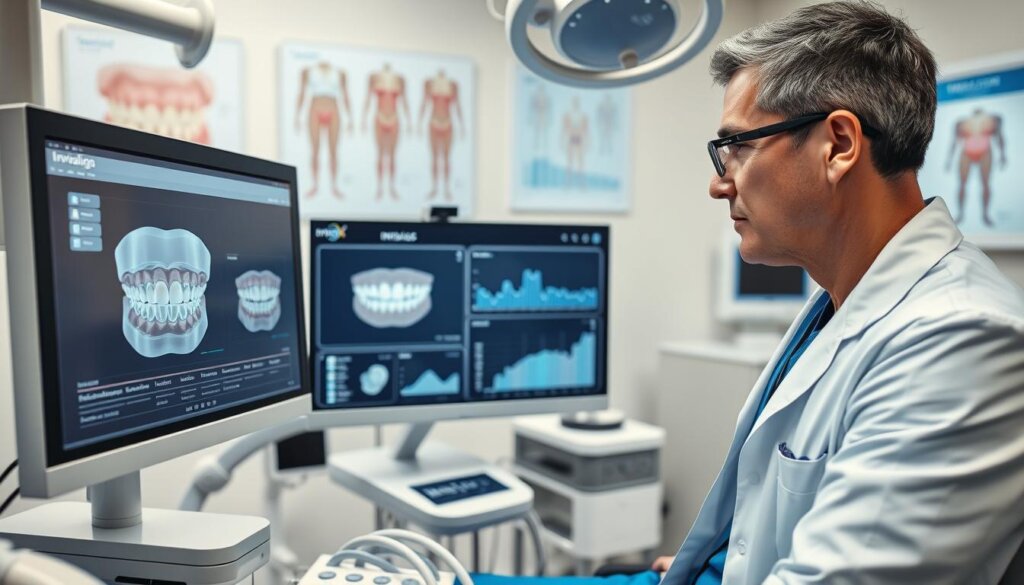
Special software then designs your treatment plan with great detail. It programs each step of your treatment. You can see how your teeth will move before starting.
This planning phase takes one to two weeks. Orthodontists fine-tune the plan to make sure it works well.
Each treatment plan is made just for you. It includes how many sets of aligners you’ll need, how long treatment will take, and any extra parts needed. Each plan is uniquely customized based on your specific needs.
Receiving Your Aligners
Once the plan is ready, your aligners are made with high precision. This takes about one to two weeks. They are made to fit perfectly and move your teeth as planned.
When your aligners arrive, you’ll get a detailed guide on how to use them. You’ll learn how to put them in and take them out, how long to wear them, and how to keep them clean. You’ll also know when to switch to the next set.
You’ll usually get several sets of aligners at once. This makes it easier to keep up with your treatment and saves you from coming back to the office too often. Most people get four to eight sets at once, covering two to four months of treatment.
By the end of this process, you’ll have your first set of aligners and know what to do next. This careful preparation ensures your treatment starts off right.
Remember, your success with Invisalign depends on following the treatment plan. The advanced technology behind Invisalign works best when you wear the aligners as directed and take good care of them.
Daily Routine with Invisalign
Wearing Invisalign as directed is key to staying on schedule. Clear aligners offer more freedom than traditional braces. Yet, they require a commitment to achieve the best results.
Starting a daily routine with your first aligner tray is essential. Unlike fixed braces, clear aligners need your active participation. The difference between on-time and late treatment completion often comes down to following the right steps.

Recommended Wear Time for Optimal Results
Orthodontic studies show that aligners should be worn for 20 to 22 hours a day. This ensures effective tooth movement. You can remove them for only two to four hours a day.
Remove your aligners for meals, drinks, brushing, and flossing. Wear them for all other activities.
Wearing aligners consistently is critical. It keeps the teeth moving in the right direction. Not wearing them enough can slow down this process.
Aligners work best when worn as directed. This keeps teeth in place while your body adapts. Removing them too often can cause teeth to move back.
Patients who don’t follow the wear schedule face several issues:
- Extended treatment duration: Not wearing aligners as directed can add weeks or months
- Poor-fitting aligners: Not wearing them enough can make them uncomfortable
- Additional refinement aligners: You might need more trays to fix issues
- Compromised final results: Inconsistent wear can prevent the best results
- Increased treatment costs: Longer treatment times and extra trays can cost more
Knowing why you need to wear aligners helps you stay on track. Each stage of treatment depends on wearing them as planned.
Building Consistency Into Your Lifestyle
Being consistent is the most important thing for Invisalign success. It’s what makes sure you finish treatment on time. How do you stay consistent for months?
Successful patients make wearing aligners a habit. Creating automatic routines helps you remember to wear them. Setting reminders and making habits can keep you on track.
Several strategies can help you stick to the wear schedule:
- Scheduled reminders: Use phone alarms to remember to put aligners back on
- Treatment tracking applications: Apps can help you track your wear time
- Aligner case accessibility: Always have your case ready to store aligners
- Routine scheduling: Plan meals and snacks at the same times to remove aligners less
- Progress photography: Take pictures weekly to see your progress and stay motivated
What makes some people stick to their treatment plan? They see their aligners as essential, not optional. They know that clear aligners need the same commitment as fixed braces.
Consistency is key to success. Patients who wear their aligners as directed usually finish treatment on time. Those who don’t may need more time and extra aligners.
Regular check-ups help you stay on track. Your orthodontist can catch any problems early, helping you stay on course. This teamwork ensures you get the best results.
Dealing with special occasions and travel requires planning. Successful patients find ways to keep up with their treatment plan even when things get busy. This dedication helps you avoid delays.
Orthodontic treatment is a big investment. It’s not just about money, but also time and effort. By understanding the importance of daily choices, you can control your treatment. Staying consistent brings you closer to your dream smile every week.
Adjustments and Monitoring Progress
Regular check-ups are key to successful clear aligner therapy. They help ensure that teeth move as planned. Unlike traditional braces, clear aligners don’t need frequent in-office adjustments.
These check-ups happen every 8 to 12 weeks. They let orthodontists see how treatment is going. This way, they can fix any problems early on.
Regular Check-ups
Patients see their orthodontist every 8 to 12 weeks. This is a big plus over traditional braces. Why is Invisalign able to go longer without needing to see the dentist?
With Invisalign, patients change their own aligners at home. They do this every one to two weeks. This makes it easier for patients to stick to their treatment plan without needing to visit the dentist too often.

During these visits, orthodontists check a few important things. They look at how well the teeth are moving compared to the plan. These visits help make sure treatment is going well.
The fewer visits needed for clear aligners don’t mean less care. It’s a smarter way to treat teeth that works better for patients and doctors alike.
Orthodontists check a few things during these visits:
- Compliance verification: They make sure patients wear their aligners enough.
- Periodontal health assessment: They check the gums and teeth for health.
- Movement accuracy: They see if teeth are moving as planned.
- Aligner fit quality: They check if the aligners fit right.
- Dispensing future aligners: They give patients the next set of trays.
Clear aligners save a lot of time compared to traditional braces:
| Treatment Aspect | Invisalign Protocol | Traditional Braces |
|---|---|---|
| Appointment Frequency | Every 8-12 weeks | Every 4-6 weeks |
| Annual Office Visits | 4-6 appointments | 8-12 appointments |
| Appointment Duration | 15-30 minutes | 30-60 minutes |
| Adjustment Type | Progress verification | Wire changes, tightening |
Tracking Progress with Attachments
SmartForce attachments are key for complex cases. They help aligners move teeth in ways traditional braces can’t. These small buttons are placed on teeth to help with movements like rotations.
Attachments make treatment faster and more effective. They work by giving the aligner a better grip on teeth. This means teeth can move more efficiently. They’re also tooth-colored, so they don’t stand out.
Attachments work by providing a surface for the aligner to grip. This creates leverage for controlled tooth movement. Different shapes are used for different movements.
The software plans where to place attachments based on:
- Specific tooth movements needed for each dental unit
- Force direction requirements to achieve planned positions
- Attachment geometry that maximizes mechanical efficiency
- Aesthetic considerations that minimize visibility during treatment
Good design and placement of attachments are key. Orthodontists can add, remove, or change them as needed. This flexibility helps achieve results similar to fixed appliances but keeps the comfort of clear aligners.
Attachments and regular check-ups make sure complex cases get the right support. These small additions help clear aligners treat more cases. They make treatment faster without sacrificing quality.
Individual Factors Affecting Duration
Every patient has a unique biological profile that affects their Invisalign journey. This means each person’s treatment time is different. The way teeth move depends on the person’s health and how complex their teeth need to be fixed.
Even though the science behind tooth movement is the same, everyone’s body is different. This is why two people with similar fixes might take different amounts of time to finish treatment.
Age and Biological Response Patterns
Younger patients often get their teeth fixed faster because their bodies are more active. Their bones are growing and changing more quickly, making it easier for teeth to move.
Younger people’s bodies are better at adapting to the forces of clear aligners. This is because they have more blood flow and cells in their bones and gums.
Does this mean adults always need more time for orthodontics? The answer is not simple.
Adults’ bones change more slowly because they are denser and less active. But, thanks to new technology, the gap in treatment time between young and old is getting smaller. Some adults move their teeth fast, while some young people move theirs slowly.
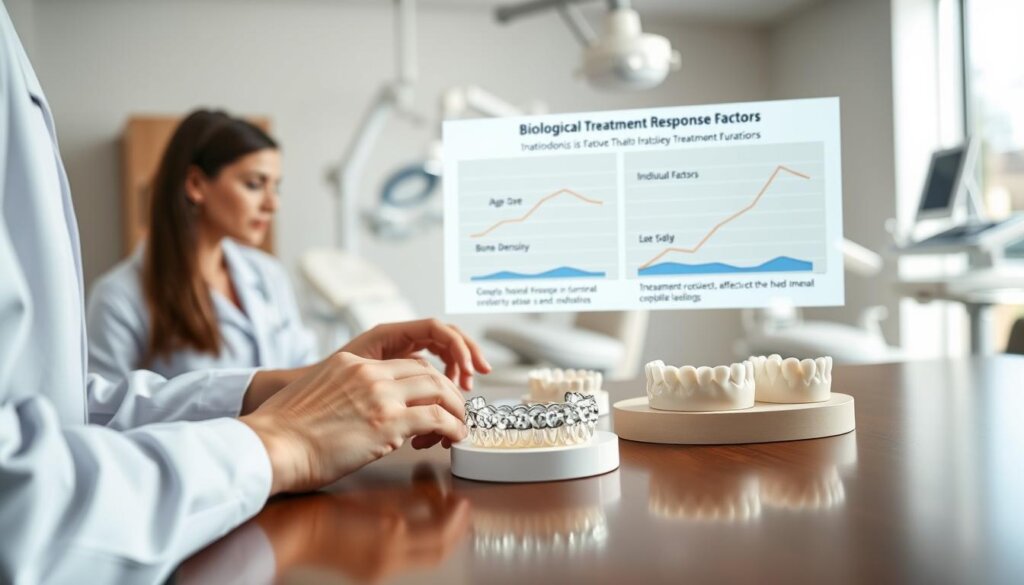
Oral health is very important for how fast treatment goes, no matter your age. If your teeth and gums are healthy, you can move through your treatment without problems.
But, if you have gum disease or cavities, you need to fix those first. This is because your teeth need to be strong and healthy to move properly.
Having healthy gums and bones is key for moving teeth correctly. Good gingival health and stable bone levels are essential for predictable tooth movement during treatment.
Orthodontic Complexity and Severity Classifications
The level of tooth misalignment affects how long treatment takes. Orthodontists use severity levels to predict how long it will take to fix teeth. These levels are based on how much teeth need to move.
For simple cases, like small crowding or spacing, treatment usually takes six to nine months. These cases need fewer aligners and involve less movement.
Moderate cases, with more crowding or skeletal issues, take twelve to eighteen months. These cases need more aligners and involve more complex movements.
Severe cases, with big skeletal issues or impacted teeth, can take up to twenty-four months. These cases need a lot of treatment and may require extra help like surgery.
Some complex cases might need extra help like temporary anchorage devices or surgery. This is because aligners alone can’t fix extreme problems.
| Severity Level | Clinical Characteristics | Expected Duration | Aligner Count Range |
|---|---|---|---|
| Simple Cases | Crowding under 4mm, minor spacing, limited rotations | 6-9 months | 12-20 aligners |
| Moderate Complexity | Crowding 4-8mm, mild skeletal issues, multiple rotations | 12-18 months | 24-36 aligners |
| Severe Malocclusion | Major skeletal discrepancies, extensive bite correction | 18-24+ months | 40+ aligners |
Everyone’s body is different, which means treatment times vary. A young person with moderate issues might move faster than an adult with simple ones, depending on their body’s response.
Our understanding of these differences is growing. Thanks to new research and technology, we can predict treatment times more accurately. This is because we can now consider both the person’s anatomy and how their body responds to treatment.
Types of Dental Issues Addressed
Knowing which malocclusion categories clear aligners can fix helps set realistic goals for treatment. Invisalign can now fix many dental alignment problems that used to need metal braces. The time needed for treatment varies a lot, depending on the problem.
Clear aligners need special plans for each orthodontic condition treated. Simple issues get fixed faster than complex ones. Wearing the aligners as directed is key to getting the best results.
The time needed for treatment depends on the dental and skeletal parts of occlusal relationship disorders. Mild to moderate misalignment usually works well with aligners. But severe cases might need more treatment or a mix of treatments.
Crowded and Rotated Teeth
Dental crowding happens when teeth don’t have enough room to line up right. This is common and often treated with orthodontics. It’s caused by teeth being too wide for the jaw space.
Mild crowding can be fixed with aligners by slowly expanding the jaw and aligning teeth. This usually takes six to twelve months. It’s a good choice for clear aligner treatment because it’s predictable.
But severe crowding is harder to fix. It might need to cut space between teeth or even pull out some teeth. This can make treatment last up to 18 months.
Rotated teeth, like canines and premolars, need special forces to straighten. Attachments on the teeth help apply these forces. They make it possible to move teeth in ways aligners can’t do alone.
Fixing crowded teeth with clear aligners works best with good planning and space analysis from the start.
Spacing Irregularities and Gaps
Spacing problems happen when there’s too much jaw space for teeth. This can make teeth look far apart. Gaps between front teeth are the most noticeable.
Small gaps close quickly with aligners. These small gaps usually fix in three to six months. It’s a simple fix because it doesn’t need complex tooth movements.
Bigger gaps take longer to close. They need teeth to move in different ways. This can take up to a year to make sure teeth move right.
When teeth are both crowded and spaced out, treatment gets harder. These mixed malocclusion categories might need 18 months of treatment. It’s a complex problem that needs a detailed plan.
Keeping gaps closed after treatment is important. Wearing retainers long-term helps keep teeth in place. This prevents gaps from opening up again.
Bite Alignment and Occlusal Issues
Bite problems affect how teeth meet when biting down. These include overbites, underbites, crossbites, and open bites. Each problem has dental and skeletal parts that affect treatment.
Overbites, where upper teeth overlap lower teeth too much, can be fixed with aligners. They use special features to guide teeth into better positions. This usually takes 12 to 18 months.
But deep overbites need more complex plans. They might need teeth to move up or down more. This can take longer, sometimes over 18 months.
Underbites, where lower teeth stick out too much, can also be fixed with aligners. But severe cases might need surgery. This is because they involve the jaw bone.
Crossbites, where upper teeth fit inside lower teeth, can be fixed with aligners. But it depends on the cause. Some cases are easier to fix than others.
Open bites, where there’s a gap between upper and lower teeth, need to address the cause. This could be thumb-sucking or tongue thrusting. Fixing these problems requires careful planning and treatment.
| Dental Condition | Severity Level | Typical Duration | Key Considerations |
|---|---|---|---|
| Crowded Teeth | Mild | 6-12 months | Responds well to expansion and alignment |
| Crowded Teeth | Severe | 18-24 months | May require IPR or extractions |
| Gaps/Spacing | Small (1-2mm) | 3-6 months | Highly predictable closure |
| Gaps/Spacing | Large (3-5mm) | 12-18 months | Requires careful root parallelism |
| Overbite | Mild to Moderate | 12-18 months | Uses bite ramps and precision cuts |
| Crossbite | Dental Origin | 10-16 months | Expansion and rotational correction |
| Underbite | Mild Dental | 15-20 months | Limited by skeletal relationship |
Orthodontic problems are grouped to help predict treatment time. Knowing your specific problem helps set realistic goals. What makes some cases harder than others? It’s the mix of problems, jaw involvement, and how severe the issue is.
Advanced imaging helps diagnose problems before treatment starts. This lets orthodontists plan the whole treatment digitally. It helps spot challenges early and plan the best approach for each case.
Comparing Invisalign with Traditional Braces
Understanding the differences between clear aligners and fixed braces helps patients make better choices. The orthodontic treatment modalities comparison looks at more than just looks. It also considers how well each works, how long it takes, and how it fits into your life.
Both methods can fix teeth problems well. But, they go about it in different ways. What should you think about when choosing between them?
Treatment Duration Comparison
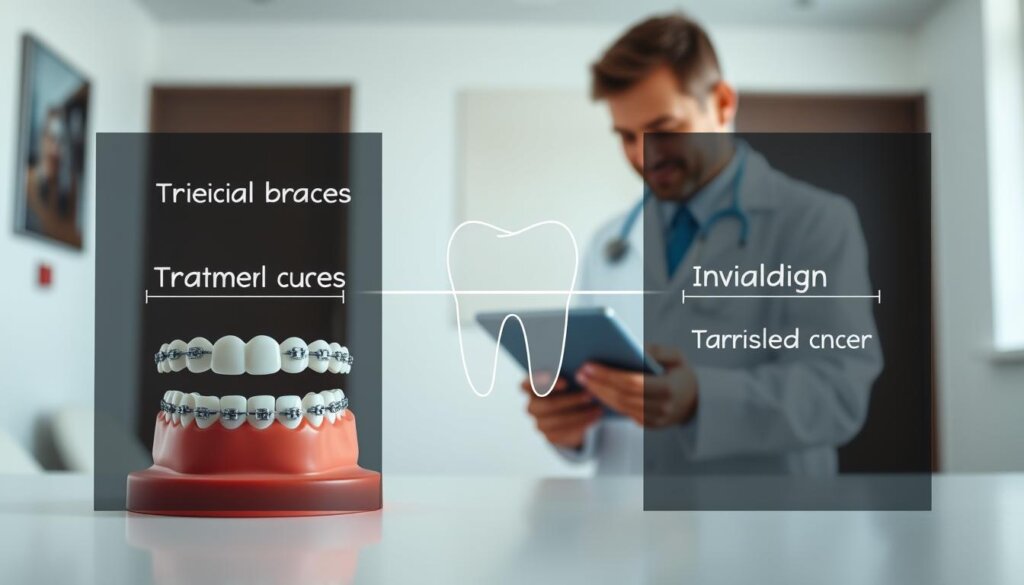
The braces versus aligners timeline shows big differences in how fast treatments can be. Studies say Invisalign is about 50% faster than metal braces for simple to moderate problems. This speed comes from new tech.
Orthodontists use digital planning to map out tooth movements before starting. This means fewer changes needed during treatment. Also, aligners apply forces in a way that moves teeth more efficiently.
| Treatment Type | Mild Cases Duration | Moderate Cases Duration | Primary Advantages |
|---|---|---|---|
| Invisalign | 6-8 months | 12-18 months | Discreet appearance, removable, fewer appointments |
| Traditional Braces | 12-18 months | 18-36 months | Handles complex cases, no compliance concerns |
| 6 Month Braces | 4-6 months | 6-9 months | Rapid cosmetic correction, fixed appliance benefits |
Looking at complex cases, the time difference is not always clear. Some cases need the detailed work of traditional braces.
Several things help Invisalign be faster in the right cases:
- Reduced emergency visits: No broken brackets or wires
- Optimized force application: Planned tooth movements
- Complete visualization: Digital plans mean no guessing
- Targeted corrections: Minor cases done in 6-8 months
Options like six-month braces are quicker for just fixing front teeth. They’re faster than full braces but don’t fix as much as Invisalign or traditional treatments.
Comfort and Aesthetics
Qualities like comfort and looks are key for patients. Many adults choose clear aligners for their look and ease of use. They’re clear and can be taken out, which is a big plus over metal braces.
Comfort is another big difference. Clear aligners usually cause less mouth irritation than metal braces. Both can be a bit uncomfortable at first, but aligners rarely cause mouth sores.
Keeping teeth clean is easier with aligners. You can brush and floss like normal, without worrying about brackets. This can help avoid problems like tooth decay and gum disease seen with fixed braces.
Lifestyle factors are important too:
- Dietary freedom: You can eat anything without worrying about brackets
- Professional appearance: Aligners are almost invisible, great for work
- Athletic activities: You can take them out for sports
- Special occasions: You can remove them for big events
But, there are downsides. Aligners need to be worn most of the time to work. If you don’t wear them as directed, treatment can take longer.
Each option has its own benefits. The best choice depends on how complex your problem is, your lifestyle, what you want to look like, and how well you can stick to treatment. Talking to an orthodontist can help you make the right choice.
Post-Treatment Process
After getting your perfect smile with Invisalign, it’s important to know how to keep it. The end of active treatment is just the start. Post-treatment stability relies on following the right retention steps, which go beyond the last aligner.
Why do orthodontic results need ongoing care? Teeth naturally try to go back to their old spots after being moved. The retention phase uses special appliances to keep teeth in place, helping them stay straight.
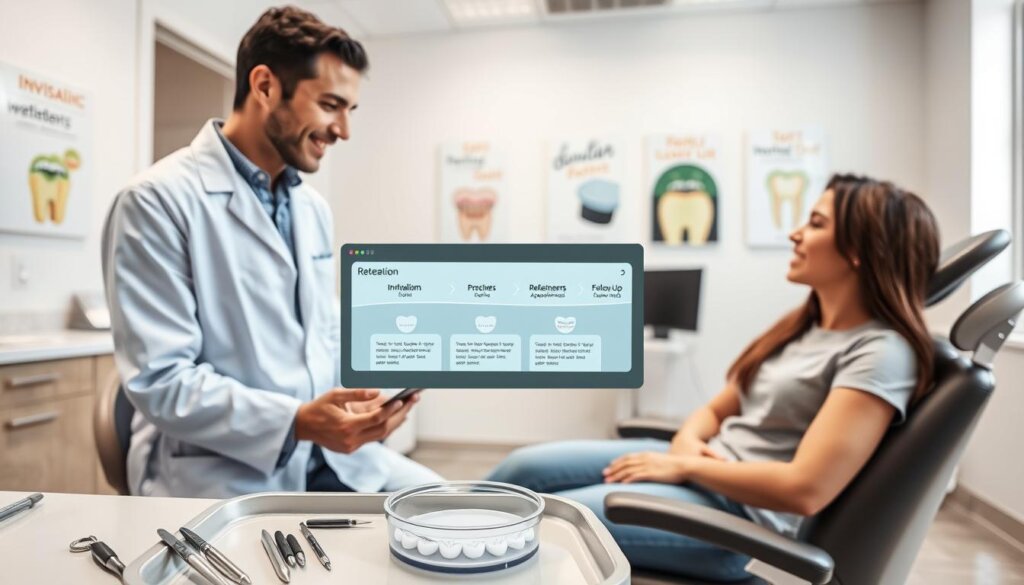
The Critical Role of Retainers
Retainers are key to keeping your smile straight after Invisalign. They keep teeth in their new spots while your mouth gets used to them. Understanding orthodontic retention protocols shows why this phase is just as important as the treatment itself.
What makes teeth want to move back? Several things can cause teeth to shift:
- Elastic periodontal fibers: These tissues stretched during treatment try to return to their original shape
- Occlusal forces: The pressure from biting and tongue can affect tooth stability
- Gingival tissue tension: The soft tissues around teeth can exert subtle pressures
- Continued facial growth: Younger patients’ faces keep growing, which can change tooth positions
There are two main types of retainers. Fixed lingual retainers are thin wires on the inside of front teeth. Removable retainers, like clear Essix or traditional Hawley designs, offer flexibility in wear.
How long should you wear retainers? Retention phase requirements vary based on several factors. Modern orthodontics often suggests wearing retainers forever.
The best retainer plan is one you can stick to. Consistency is key to keeping your teeth straight.
Here’s how retention usually starts:
- First 3-6 months: Wear retainers all the time, except during meals and brushing
- Months 6-12: Start wearing them only at night
- Beyond one year: Keep wearing them at night forever to keep teeth stable
Many orthodontists now say to wear retainers at night forever. This keeps teeth from shifting over time. The small effort of nightly wear is worth it to avoid costly retreatment.
Strategies for Long-Term Success
During the retention phase, being responsible is key. Long-term results maintenance requires less effort than wearing aligners all day. But, you must stick to the plan to avoid needing to do it all again.
What habits help keep teeth straight? Success in retention depends on a few things:
- Consistent wear compliance: Stick to the retainer schedule without missing nights
- Proper retainer care: Clean them daily to prevent bacteria buildup
- Regular dental monitoring: Go to check-ups to make sure teeth and retainers are okay
- Prompt replacement: Get new retainers if the old ones show wear or damage
- Awareness of risk factors: Know things that might make your teeth move, like wisdom teeth or grinding
When should you replace retainers? Clear ones need to be replaced every 12-24 months. Fixed retainers might last years but need dental checks to make sure they’re working right.
Dental exams are important for keeping retainers working. They let your orthodontist catch small movements early. This can stop big problems before they start.
Long-term results maintenance also means knowing about things that can affect your teeth. Things like wisdom teeth coming in or grinding can make teeth move. Gum disease can also weaken teeth, making them more likely to shift.
If you notice your teeth moving, see your orthodontist right away. Catching small changes early can make fixing them easier. Sometimes, just wearing retainers more can fix small issues without needing new aligners.
The retention phase is a key part of orthodontic retention protocols. It may take less time each day than treatment, but it lasts forever. By making retention a part of your daily routine, you can keep your smile beautiful and healthy for life.
Understanding that orthodontic treatment is not just about fixing teeth but also about keeping them straight is important. The small effort of wearing retainers at night protects the big investment of aligner treatment. Seeing retention as a lifelong commitment helps keep your smile perfect.
Tips to Speed Up Invisalign Treatment
While we can’t move teeth too fast, there are ways to make treatment faster. By using treatment acceleration strategies, patients can finish their orthodontic treatment weeks or months early. These strategies include changing how we behave and using special devices to help aligners work better.
Invisalign works by applying steady pressure over time. If we don’t follow the plan, treatment can take longer. Using compliance enhancement methods and auxiliary orthodontic devices helps patients control their treatment time.
Maintaining Consistent Daily Wear
The key to optimizing orthodontic efficiency is wearing aligners as directed. Studies show that wearing them for 22 hours a day makes a big difference. But how do we make sure we wear them every day?
Creating routines helps make wearing aligners a habit. By linking aligner wear to daily activities like eating and brushing teeth, it becomes easier. Using apps on our phones can also remind us to wear them.
Keeping a log of our treatment can help us stay on track. It shows us if we’re doing well or need to make changes. This helps us catch any problems early.
Seeing how our teeth change can also motivate us. Looking at before and after photos helps us stay committed to wearing our aligners every day. This motivation comes from seeing the progress ourselves.
Even small changes in wear time can affect treatment length. Wearing them for 18 hours instead of 22 can make treatment 25-50% longer. Carrying a travel oral hygiene kit helps us put our aligners back on right after meals.
Maximizing Fit with Aligner Seating Devices
Using Invisalign chewies is a simple but effective way to speed up treatment. These small devices help aligners fit better by applying even pressure. How do they help?
Without chewies, aligners might not fit perfectly, which slows down treatment. Chewies help aligners fit snugly by applying pressure. This ensures that the aligners work as planned.
Chewing on these devices for a few minutes after putting in aligners helps. It’s important to chew on different parts of the mouth each time. This ensures that all teeth are properly aligned.
The chewies work because of their material and how they respond to pressure. They compress and then rebound, pushing the aligner against the teeth. This process helps eliminate air pockets that reduce the effectiveness of the aligners.
| Acceleration Strategy | Implementation Method | Expected Impact | Compliance Difficulty |
|---|---|---|---|
| Digital Impressions | Request advanced scanning technology during initial consultation | Superior initial accuracy reduces need for mid-course corrections | Low (one-time decision) |
| SmartForce Attachments | Accept recommended attachment placement from orthodontist | Expanded mechanical capabilities enable complex movements | Low (clinical procedure) |
| Prescribed Wear Schedule | Maintain 20-22 hours daily wear without deviation | Prevents 25-50% treatment extension from reduced wear time | High (requires daily discipline) |
| Timely Aligner Switching | Advance to new aligners every 1-2 weeks as instructed | Maintains optimal force application throughout treatment | Medium (requires attention to schedule) |
| Optimal Oral Hygiene | Brush teeth before replacing aligners after meals | Prevents treatment-disrupting dental disease and delays | Medium (multiple daily instances) |
There are more ways to speed up treatment beyond just wearing aligners and using chewies. Choosing a dentist who uses digital impressions can make treatment more accurate. This means fewer changes during treatment.
Cleaning aligners properly is also important. Avoid using toothpaste, as it can scratch the aligners. Instead, use soap and water to keep them clean.
Going to all scheduled check-ups is key. These visits help catch any problems early. Even small issues can add weeks to treatment if not fixed right away.
Using these compliance enhancement methods together can make treatment faster. While we can’t move teeth too fast, these strategies help treatment go as quickly as possible. Patients who use many of these strategies at once see the biggest improvements in treatment time.
Success Stories with Invisalign
Invisalign success stories show how clear aligners can change lives. They highlight the importance of patient commitment and expert care. These stories give future patients a clear idea of what to expect.
Real-life experiences show that success is not just about the technology. It also depends on how well patients follow their treatment plans. This includes staying motivated and setting realistic goals.
Real Patient Testimonials
Real patients share their experiences, showing common themes. Those who got clear timelines and realistic expectations were happier. A 28-year-old professional, for example, was glad he wore his aligners 22 hours a day.
Teenagers like the look of clear aligners during important years. A 16-year-old finished treatment in 14 months, saying seeing results early helped him stay on track.
Adults over 35 often thank Invisalign for fixing long-standing issues without the look of braces. They say the first fears about discomfort or lifestyle changes were wrong. They praise their doctors for being honest about treatment times.
Patients who needed extra aligners share valuable insights. They see these as tools for better results, not failures. This view helps them stay satisfied with their treatment, no matter the complexity.
Before and After Transformations
Photos show how much Invisalign can change smiles. They help people see if clear aligners can fix their issues. These pictures show the range of problems Invisalign can solve.
For small to medium crowding, treatment is often quick, 6-10 months. A 32-year-old with 4mm crowding finished in 8 months. The before-and-after photos showed big improvements, thanks to daily wear.
More complex cases, like Class II malocclusion, take longer but are possible. A 42-year-old with many issues finished in 18 months. The photos and scans showed big improvements, proving clear aligners can work for complex cases.
When treatment takes longer than expected, patterns emerge. Issues like inconsistent wear, biological responses, and complications can cause delays. But, if doctors explain the reasons, patients stay happy.
What makes some treatments faster? Motivated patients with mild crowding and few skeletal issues do well. They get great results quickly, thanks to good planning and commitment.
Common Misconceptions About Invisalign
Orthodontic care has changed a lot, but old beliefs about clear aligners are stuck. These orthodontic treatment myths come from old aligner systems. Talking clearly about these myths helps patients make better choices.
Why do aligner therapy misconceptions keep showing up? It’s because of old stories, limited knowledge, and old technology. Knowing the truth is key to helping patients.
Two big myths need to be cleared up. One is that clear aligners only fix small problems. The other is that they take longer than traditional braces.
Beyond Minor Adjustments: Comprehensive Treatment Capabilities
Many think Invisalign is only for small fixes. But how did this myth start? Old clear aligners couldn’t handle complex tooth movements well.
New technology has changed that. Better materials and designs now handle tough cases. Treatment plans are smarter too.
Now, Invisalign can fix many problems. It works for crowded teeth, big gaps, and even some bite issues. It’s not just for small fixes anymore.
But, there are limits. Some cases need surgery or traditional braces. Some teeth are too rotated or impacted for aligners.
Despite these limits, more people can use Invisalign. Studies show seventy to eighty percent of orthodontic cases can be treated with aligners. This shows the myth of limited use is wrong.
Treatment Duration: Separating Perception from Reality
Another myth is that Invisalign takes longer than traditional braces. But, studies show aligners can work faster for many cases.
Why do people think this, even when the facts say the opposite? It’s because of old stories and misunderstandings. People often confuse total time with active treatment time.
Old stories about long braces treatments stick in people’s minds. This makes them think aligners are slower, even when they’re not.
But, the truth is different. For the right cases, Invisalign can be just as fast as traditional braces. It usually takes twelve to eighteen months, which is similar to traditional treatments.
Studies show Invisalign can be fifty percent faster than traditional braces for similar cases. This is because of better planning and consistent forces.
Telling patients and doctors the truth helps them choose the right treatment. Knowing what to expect makes everyone happier with the results. Fixing these myths is important for good patient care.
Future of Invisalign Technology
Orthodontic innovation is moving fast toward a future where treatments are faster, more precise, and tailored to each patient. The field of clear aligner therapy is on the verge of big advances. These changes will change how we do orthodontics and how patients feel about it.
By using digital diagnostics and computational analysis, we can make treatments better. Advanced software looks at lots of data to predict how well treatments will work. This is a big change in how orthodontists plan and do treatments.
Emerging Technologies Reshaping Treatment
New technologies could make treatments shorter and open up new possibilities. Artificial intelligence applications look at millions of cases to make better treatment plans. They find the best ways to move teeth for each patient.
What new technologies are most promising? The current scene shows a few key areas:
- AI-Driven Treatment Planning: AI systems make treatment plans that are very accurate. They might need fewer aligners.
- Advanced Polymer Materials: New aligner materials can remember their shape better and work well in different temperatures.
- Photobiomodulation Therapy: Light therapy can make teeth move faster, cutting treatment time by up to 30%.
- Minimally Invasive Adjuncts: Tiny holes in the bone can make teeth move faster by increasing bone activity.
- Enhanced Imaging Integration: Using scans and X-rays together helps plan treatments more accurately.
Remote monitoring is another big step forward in orthodontic technology advancement. Using phones and AI, treatments can be checked more often without needing more visits. This helps find and fix problems sooner.
New materials are making aligners better. Researchers are making materials that work well in the mouth and move teeth predictably.
Photobiomodulation therapy is a new way to help teeth move. It uses light to help the body move teeth faster. Early tests show it works well and is safe.
Individualized Protocols and Patient-Centered Care
Orthodontics is moving toward treating each patient differently. This change is because everyone responds differently to treatment. Treatments are now made to fit each person’s needs better.
How does this change orthodontics? A few key things show how it’s happening:
- Genetic Marker Analysis: Finding genes that affect how fast teeth move can help plan treatments better.
- Patient-Specific Biomechanical Modeling: Computer models based on each patient’s teeth and jaw help plan treatments.
- Compliance-Adaptive Planning: Treatment plans can change based on how well a patient follows instructions.
- Preference-Informed Decision Making: Patients help decide what they want from their treatment, like how fast or how good it should look.
- Biological Response Monitoring: Tracking how a patient’s body reacts to treatment helps adjust it as needed.
Using computer models to plan treatments based on each patient’s unique anatomy is a big step. These models help plan the best way to move teeth for each person.
Genetic markers might soon help predict how fast teeth will move in each patient. This could make treatments shorter for some and safer for others.
The future of orthodontics is not just about teeth. It’s about understanding and working with each person’s unique biology.
Using AI to track how well patients follow treatment plans is a big step. It helps make plans that work better for each person. This makes treatments more likely to succeed without needing to change plans often.
Orthodontics is becoming more about what each patient wants and needs. It’s not just about the teeth. It’s about making sure treatments fit each person’s values and goals.
These changes are making orthodontics better for patients. It’s moving from one-size-fits-all to treatments that are truly made for each person. Future treatments will likely use many of these personalization strategies together.
The mix of precision medicine in orthodontics and new digital tools is leading to better treatments. Each patient helps improve treatments for others by adding to the data. This cycle of improvement is making orthodontics better for everyone.
Frequently Asked Questions
Clear aligner therapy is a big step in orthodontic care. It’s important for patients to understand the process well. This helps them feel more confident and informed about their treatment.
Orthodontic specialists often get asked the same questions. These questions help patients make the right choices for their teeth.
How Do I Know If Invisalign Is Right for Me?
Figuring out if Invisalign is right for you needs a detailed check-up. Experts look at more than just how your teeth look. They consider your health and personal factors that affect treatment success.
Invisalign can fix many issues like crowded teeth and gaps. It’s best for dental problems, not big jaw issues. For serious jaw problems, you might need other treatments like braces or surgery.
- Severity of malocclusion: Mild to moderate cases respond well to clear aligners
- Periodontal health: Gum disease needs treatment before starting orthodontics
- Dental restorations: Lots of bridgework or missing teeth can make treatment harder
- Temporomandibular joint health: TMJ problems need to be fixed before moving teeth
- Oral hygiene habits: Good dental care is key for success
Personal factors also play a big role. You need to wear the aligners 20-22 hours a day. People who are responsible and motivated do best.
Teenagers need to show they can handle wearing the aligners. Parents should think if their teen can do it. Adults usually do better because they care more about the results.
What you do every day also matters. People who need to look good for work might like clear aligners. But, if you eat a lot or talk a lot, wearing them might be hard.
When you see your orthodontist, they will check your teeth and talk about treatment. They will tell you if Invisalign is best for you. They might suggest other options too.
What If I Lose an Aligner?
Lost or damaged aligners are a big worry. What to do depends on when you lost it. Knowing what to do helps keep your treatment on track.
If you lost it early, you should go back to the last one. Tell your orthodontist right away. This keeps your teeth in the right place while you get a new one.
If you lost it later, your orthodontist might say to move to the next one. They need to check if your teeth have moved enough. Never move to the next one if it doesn’t fit right. This can mess up your treatment.
Not wearing your aligners right can mess up your treatment. Each one builds on the last. Skipping or delaying can slow things down. Your orthodontist might give you extra aligners or make new ones fast.
Here are some tips to avoid losing your aligners:
- Make a routine for taking them out and putting them back in
- Always use the case they gave you, not napkins or pockets
- Keep track of where your aligners are when you’re not wearing them
- Keep old aligners as backups until you’ve made good progress
- Carry both your current and next aligners when you travel
These tips might seem small, but they’re important. Starting good habits early helps avoid problems. Your orthodontist will help you with any challenges you face during treatment.
Conclusion on Treatment Duration
Clear aligner therapy needs careful thought about many factors. It can last from three months for small fixes to eighteen months for big changes. Most people finish in twelve to eighteen months. Success depends on how complex the case is, how well the patient follows instructions, and how their body reacts.
Essential Duration Factors
Patients play a big role in how fast their treatment goes. Wearing aligners for twenty-two hours a day, going to appointments, and keeping teeth clean are key. For the right cases, clear aligners can be fifty percent faster than metal braces.
But, keeping teeth straight after treatment is a lifelong job.
Taking the First Step
First, book a visit with an orthodontist who knows clear aligners well. It’s smart to look at different plans and ask about the doctor’s experience. You should also ask about how long treatment will take and how much it will cost.
Looking at before-and-after photos of similar cases is a good idea. Knowing the costs and effort needed helps make a better choice. Remember, the time and money needed are just estimates. How well you do and how your body reacts can change things.

