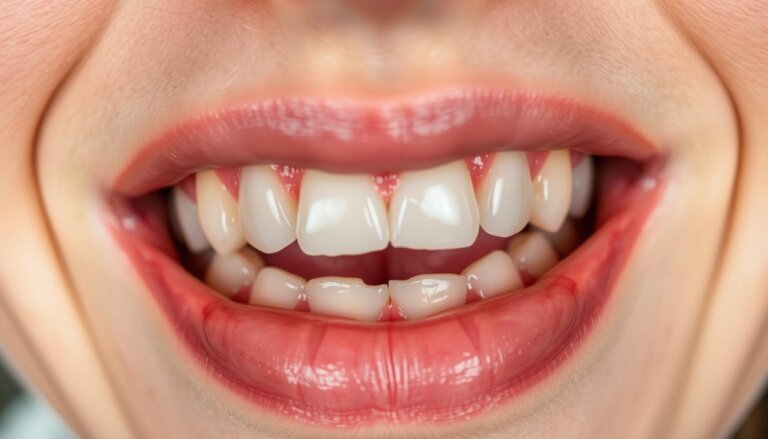
Why Are My Teeth Sensitive After Whitening?
Whitening gel works by sending the peroxide through the enamel and into the dentin beneath. On its way through, it irritates the nerve in the center of the tooth and that’s why your teeth feel sensitive after whitening. It’s usually a dull ache or a quick electric “zinger” and it will be gone in 24 to 48 hours. If it persists beyond a few days or settles into one tooth, you should call your dentist.
It’s by far the most common side effect of professional teeth whitening (both in the clinic and with the take-home trays) and it’s one that often catches people by surprise on the first evening, typically at the moment they reach for a glass of ice water. At our Upper East Side practice we use Zoom! and SinSational Smile, and sensitivity to hot and cold for a day or two following a Zoom! treatment is something we always mention before anyone starts.
Why does whitening make teeth sensitive?
Enamel appears solid, but in fact it’s a dense lattice of mineral rods with very small gaps between them. Beneath that is dentin, which is threaded with thousands of microscopic tubules that run all the way to the pulp, where the nerve and blood supply of the tooth are located. Hydrogen peroxide is a small molecule and so it can move through the enamel and into those tubules very quickly. Lab studies have shown it can reach the pulp chamber in just a few minutes. That’s how the whitening works in the first place, as the peroxide has to get inside the tooth to break up the stain molecules in the dentin.
The pulp reacts to the peroxide with a very mild, transient inflammation (that’s the ache you feel). Whitening also has a drying effect on the teeth for a while, and slightly dehydrated teeth are more sensitive to temperature change. The ADA’s page on sensitive teeth does a good job of explaining the general mechanism: the stimulus traveling down the dentinal tubules to the nerve gives you that sharp little jolt of pain. Carbamide peroxide (which is used in a lot of the take-home gels) breaks down into hydrogen peroxide in the mouth, so the same thing occurs with the trays, just much more slowly.
How long does sensitivity after whitening last?
After an in-office session, sensitivity will usually peak that evening and be gone in one to two days. With trays, it can come and go throughout the course of treatment, flaring up after each tray is worn and settling down in between, and it’ll typically be sorted out within a day or so of finishing. The “zingers” (those sudden electric twinges that seem to just appear out of nowhere while you’re sitting on the couch reading) will tend to be in clusters over the first few hours and then they’ll fade.
If you’re doing it in the build-up to a big date on the calendar (a wedding, say), give yourself a good week or so. Our article on how far before a wedding to schedule whitening goes into the timing, including time to allow for any sensitivity to subside and for the shade to settle.

Who is more likely to get sensitive teeth after whitening?
The best predictor is actually how your teeth are behaving at the moment. If a sip of ice water is enough to cause a toothache, the dentin is already responding and the peroxide will just add to the load. A thorough pre-whitening examination will usually include a quick puff of air from the air-water syringe across each tooth. The ones that flinch get a more detailed examination, as the cause is often quite apparent: a strip of root showing where the gum has retracted (root surfaces are covered in cementum, which is considerably thinner than enamel), a small notch at the gumline from years of using a hard brush, or a hairline crack in a molar.
Underpinning all of this is one principle: the thinner the barrier between the gel and the pulp, the faster the peroxide gets through and the more the nerve will complain. The higher the strength of the gel and the longer the wear, the more peroxide will get through. A tray designed for an hour which you end up wearing all night is asking for trouble. An untreated cavity is even worse and should be filled before any whitening, as peroxide getting into an open cavity can lead to the sort of pain that will have people calling the practice for an emergency visit.
What helps sensitivity after whitening?
Desensitizing toothpastes work in two ways. Potassium nitrate (5% in many Sensodyne formulas and most of the drugstore sensitivity pastes) works by calming the nerve itself, as the potassium ions make the nerve fibers less excitable. Stannous fluoride (as in Crest Pro-Health) works in a more plug-like fashion, effectively plugging the open ends of the dentin tubules. Neither works overnight, and the ADA points out that desensitizing toothpaste generally takes several applications to have any effect, so it makes perfect sense to start one about two weeks before the whitening and continue using it right through the treatment. Spitting without rinsing at bedtime will leave a little more of it on the teeth.
If sensitivity is building up during a tray course, the simplest thing to do is to give the pulp more recovery time. Thirty minutes rather than an hour, or every other day rather than every day, will still move the shade, just more slowly. Some dentists will also send you home with a fluoride or potassium nitrate gel which you put into the trays on your rest days. After an in-office visit, room-temperature water and a straw for anything iced make the first evening a lot easier, and if you’re normally able to take an over-the-counter painkiller, a dose at bedtime as per the label is perfectly reasonable.
When should you call your dentist?
Call if the sensitivity goes on for more than a few days, if it’s throbbing or wakes you up, or if it’s one specific tooth that’s painful on biting. Those are the sorts of things that suggest something other than normal whitening sensitivity (a crack, a cavity or a nerve that was already irritated). White or sore patches on the gums are generally just the result of the gel coming into contact with the gum tissue and will go away in a day or two. Just let your dentist know if they don’t. Sensitivity following a routine cleaning is a different matter entirely, and our post on whether teeth feel sensitive after a cleaning covers that situation.
Frequently asked questions
Is it normal for teeth to hurt after Zoom whitening?
For a day or two, yes. The in-office gels are far stronger than the take-home ones, so some response to hot and cold is to be expected and that will typically sort itself out by the second morning. Any pain that’s severe enough to make eating difficult is definitely worth a call.
Should I stop whitening if my teeth are sensitive?
With trays, a break of a day or two is often sufficient, after which you can go back to shorter wear times. If it’s coming back again, it’s worth asking your dentist about a lower-strength gel.
Does sensitivity mean the whitening damaged my teeth?
Normal post-whitening sensitivity is the pulp responding to the peroxide, and it goes away on its own. A tooth that’s still in pain a week later is a different matter and warrants an examination and an X-ray.
Whitening with sensitivity in mind on the Upper East Side
Sensitive teeth very rarely rule out whitening, though they do affect how the treatment is carried out. If you have a history of sensitive teeth, it’s important to mention this when you book. VisoDent NY is at 903 Park Ave, New York, NY 10075 (Upper East Side). Call 212-991-9095 and we’ll find a time that works for you.