
Ultherapy Aftercare: What to Expect After Treatment
One of the advantages people often hear about Ultherapy is that there is “no downtime.”
That phrase can be a little misleading if it makes you think your skin will always look and feel exactly the same the moment treatment ends.
Ultherapy is non-surgical, so there is no incision and usually no traditional recovery period. Most people can return to normal activities after treatment. At the same time, temporary redness, swelling, tenderness, tingling, or other short-term reactions can happen.
Knowing what may happen afterward makes the experience much easier to understand — especially if you are planning Ultherapy around work, social events, or travel.
What happens immediately after Ultherapy?
Right after treatment, the skin may look slightly flushed.
According to Ultherapy’s official patient information, redness generally fades within a few hours. Some patients may also experience mild swelling, tingling, or tenderness to the touch. These reactions are generally temporary.
You may also feel that certain areas are more sensitive than usual.
That does not necessarily mean something is wrong. The treatment delivers focused ultrasound energy below the skin, and the tissue begins responding to that energy after the appointment.
The important thing is to follow the instructions given by your practitioner rather than comparing your experience with someone else’s treatment online.
Is there downtime after Ultherapy?
Ultherapy is generally considered a treatment with no downtime.
In practical terms, that means most people do not need to take several days away from work or normal daily activities simply because they had the procedure. Official Ultherapy guidance says normal activities can generally be resumed immediately after treatment, while following the practitioner’s instructions.
This is very different from saying that every patient will have zero visible or physical reaction.
You might have an appointment in the morning and feel completely comfortable going back to your normal schedule. Someone else may have mild redness or tenderness and prefer a quieter day.
Both can fall within the range of normal post-treatment experiences.
Can you wear makeup after Ultherapy?
For many people, yes.
Cleveland Clinic notes that makeup can generally be worn immediately after Ultherapy and that patients can return to their normal skincare routine after treatment.
Still, follow the specific instructions you receive at your appointment.
If the skin feels particularly sensitive, irritated, or uncomfortable, your practitioner may recommend adjusting part of your routine temporarily.
This is also a good reason to bring your skincare questions to the consultation before treatment. If you regularly use retinoids, acids, prescription products, or other active skincare ingredients, ask whether anything in your routine should be changed.
What does the skin feel like during the first few days?
The most common post-treatment experience is usually fairly simple: the area may feel a little different.
Some people notice tenderness when touching the skin. Others describe mild swelling, tingling, or sensitivity.
Official clinical information for the Ulthera System reports temporary reactions including redness, swelling, discomfort, tenderness, bruising, and transient nerve-related effects. The frequency, intensity, and duration are not identical for every patient.
This is why it is better to think in terms of a normal range of possible reactions rather than expecting one exact recovery timeline.
Your practitioner should explain what they expect in your particular treatment area and what symptoms would warrant a call.
Does swelling mean the Ultherapy result is already visible?
Not necessarily.
This is an important distinction.
An early change in the mirror may partly reflect temporary tissue response rather than the eventual treatment result.
Ultherapy works by stimulating a gradual collagen response. The more meaningful visible changes usually develop over the following months rather than immediately after treatment. Official Ultherapy information says the ultimate results generally develop over about two to three months as new collagen and elastin develop.
So it is usually too early to evaluate the outcome a few days after your appointment.
When should you take before-and-after photos?
Before-and-after photographs are most useful when they are consistent.
Try to use:
- similar lighting;
- the same camera position;
- the same head angle;
- a relaxed facial expression;
- similar distance from the camera.
Otherwise, a small difference in lighting or posture can create a bigger visual change than the treatment itself.
A photo taken the morning after treatment also should not be treated as the final “after” image.
Ask your practitioner when they recommend evaluating your progress. Because Ultherapy results develop gradually, meaningful comparisons are usually made over a longer period.
Can you go back to work after Ultherapy?
For most people, normal activity can resume immediately after treatment.
That is one of the reasons Ultherapy may appeal to people in New York who do not want a procedure requiring a lengthy recovery period.
However, consider your own comfort level.
If you have an important presentation, professional photography session, wedding, or another event where even temporary redness or swelling would bother you, it may be sensible to avoid scheduling the treatment immediately beforehand.
“No downtime” is not the same thing as guaranteeing that nobody will notice any temporary reaction.
Should you massage the treated area?
Do not add your own post-treatment techniques unless your practitioner has specifically recommended them.
That includes aggressive massage, devices, or other treatments intended to “improve” the result.
Ultherapy energy is delivered according to a planned treatment pattern and depth. More manipulation afterward does not automatically mean a better outcome.
If something feels unusual or you are unsure whether you should massage, cool, moisturize, or otherwise treat the area, ask the practitioner who performed the procedure.
What about exercise, heat, or other cosmetic treatments?
Post-treatment instructions can vary depending on the area treated, your skin, your medical history, and other procedures you may be considering.
Rather than following a generic internet checklist telling everyone to stop exercising, avoid heat for a fixed number of days, or discontinue specific products, get instructions that apply to your treatment.
This is especially important if you are planning additional aesthetic procedures.
Ultherapy, fillers, neuromodulators, lasers, microneedling, and other treatments do not automatically belong on the same schedule for every patient.
The sequence and timing should be decided by qualified providers who know what treatments you have received.
What reactions should you watch for?
Mild temporary redness, swelling, tenderness, or tingling can occur after treatment.
But you should not assume that every symptom is something you simply need to wait out.
Contact your treatment provider if:
- a reaction feels unusually severe;
- symptoms are getting worse rather than improving;
- you develop something you were not told to expect;
- you have persistent numbness, weakness, significant pain, or another neurological symptom;
- you are simply uncertain whether what you are experiencing is normal.
Official Ulthera safety information describes less common adverse events in addition to the more familiar temporary reactions, which is why patients should have a clear way to contact their provider after treatment.
When in doubt, asking is better than trying to diagnose a reaction from photographs or comments online.
How soon should you expect Ultherapy results?
Recovery and results are two separate timelines.
Your skin can feel normal again well before the treatment has produced its more noticeable cosmetic effect.
Ultherapy stimulates the body’s own collagen response, so the outcome develops gradually. Some initial change may be visible earlier, but official patient guidance places the more developed result around two to three months after treatment.
That is why patience is part of the process.
If you are only a week or two past your appointment, you are still very early in the timeline.
For a more detailed explanation of the technology, treatment areas, and what happens during an appointment, visit our Ultherapy treatment page in New York.
How can you make the recovery period easier?
The best aftercare plan is usually not complicated.
Follow the instructions you receive from your practitioner, avoid experimenting with treatments they have not recommended, and give the tissue time to respond.
It also helps to understand in advance that:
- temporary reactions are possible;
- the final result is not immediate;
- your experience may differ from another patient’s;
- questions after treatment are worth asking.
A realistic timeline removes a lot of unnecessary worry.
Is Ultherapy right for everyone?
No cosmetic treatment is right for everyone.
A proper evaluation should consider the area you want treated, the degree and type of skin laxity, your medical history, previous cosmetic procedures, implants or devices, and what kind of result you expect.
The Ulthera System also has specific contraindications and safety considerations that should be reviewed before treatment.
If you are researching aesthetic options in New York and want to explore the broader clinic and available services, you can also visit the VisoDent NYC homepage.
Questions to ask before you leave your appointment
Before walking out of the clinic, make sure you know the answers to a few practical questions:
What reactions should I expect today?
Ask specifically about redness, swelling, tenderness, and sensation in the area treated.
Can I use my normal skincare tonight?
Your practitioner can advise based on your products and skin.
When should I contact you?
Know which symptoms should trigger a call and how to reach the office.
When should we evaluate the result?
Do not assume that the first few days represent the final outcome.
Can I schedule another cosmetic treatment soon?
Ask before combining procedures or building your own treatment calendar.
These are simple questions, but they can prevent a lot of confusion afterward.
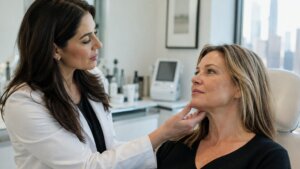
Ultherapy follow-up consultation in New York City focused on aftercare, recovery, and expected results over time.
The Bottom Line
Ultherapy recovery is generally much easier than recovery from a surgical procedure because there are no incisions and typically no required downtime.
Still, “no downtime” does not mean “nothing happens.”
Temporary redness, swelling, tingling, tenderness, bruising, or other short-term reactions can occur. Your skin may return to its normal routine quickly, while the cosmetic result itself continues developing over the following months.
The best approach is straightforward: understand what is normal, follow your practitioner’s aftercare instructions, do not judge the result too early, and contact the office if something feels outside the expected range.

