
What If I Don’t Wear Aligners the Recommended Time?
Ever thought skipping a few hours of aligner use could mess up your whole orthodontic treatment? This is a big worry for those choosing clear aligner therapy for a straighter smile. Knowing the effects of not wearing them as directed is key for the best results.
Clear aligner therapy guidelines say you must wear your trays for at least 22 hours a day. This isn’t just a rule. Studies show that sticking to this aligner wear compliance makes you 2.5 times more likely to finish treatment on time compared to those who don’t.
The science behind this strict rule is about how teeth move. Aligners work by applying gentle, constant pressure to your teeth all day and night. This steady pressure helps teeth move slowly and predictably into their new spots.
But, if you don’t wear them enough, this pressure stops. The process of teeth moving needs constant pressure to change the bone and tissue around each tooth. Not getting this can really hurt your treatment success.
Key Takeaways
- Clear aligners need to be worn for at least 22 hours a day for effective teeth movement and treatment success
- Patients who stick to the proper wear-time schedule are 2.5 times more likely to complete orthodontic treatment on time
- Aligners work by applying continuous gentle pressure that must stay consistent all day
- Not wearing them enough can stop the tooth movement process and delay treatment results
- Understanding clear aligner therapy guidelines helps patients make informed decisions about their commitment level
- Aligner wear compliance is the most important factor under patient control for treatment success
Understanding Aligners and Their Purpose
Clear aligners work by moving teeth through consistent wear. This method is a key part of modern dentistry. It offers a discreet way to straighten teeth, unlike traditional braces.
The success of clear aligners depends on understanding how they work. This includes knowing the mechanical principles and the importance of following a wearing schedule. Each aligner is made to move teeth a little bit at a time.
Knowing the science behind clear aligners helps patients stick to their treatment. This knowledge boosts compliance rates.
Let’s look at how clear aligners move teeth. This knowledge helps patients understand why wearing them as directed is important.
The Biomechanical Process of Tooth Realignment
Clear aligners apply gentle pressure to teeth. They are made from materials that fit each patient’s mouth perfectly. This pressure starts a process that moves teeth through the bone.
The process starts with pressure on the periodontal ligament. This is the tissue that holds teeth in place. The pressure causes cells to break down bone, making room for teeth to move.
“Orthodontic tooth movement is a biological response to mechanical forces, requiring a delicate balance between bone resorption and formation to achieve stable results.”
On the other side, new bone is formed. This happens because of the stretching of the periodontal ligament. This process needs constant pressure from the aligners. Without it, teeth can move back to their original place.
Each set of aligners moves teeth a small amount. This movement is based on the patient wearing the aligners for 22 hours a day. The remaining two hours are for eating, drinking, and cleaning teeth.
Advantages of Maintaining Treatment Consistency
Wearing aligners consistently has many benefits. It helps teeth move as planned and makes treatment more comfortable. It also makes the treatment more predictable.
Being consistent helps teeth move as planned. This means less need for changes in treatment. It also means fewer additional aligners.
Wearing aligners regularly also reduces discomfort. When aligners are removed often, teeth can move back. This creates discomfort when putting the aligners back on.
| Wear Consistency Level | Treatment Completion Rate | Average Treatment Duration | Refinement Aligners Needed |
|---|---|---|---|
| 22+ hours daily | 92% | 12-18 months | 0-1 sets |
| 18-21 hours daily | 67% | 18-24 months | 2-3 sets |
| 15-17 hours daily | 45% | 24+ months | 3-5 sets |
| Less than 15 hours daily | 28% | Indeterminate | 5+ sets or treatment abandonment |
Wearing aligners as directed also keeps teeth and gums healthy. Irregular wear can harm the gums and teeth. This can make treatment less effective.
Patients who wear aligners as directed also have better gums and cheeks. The mouth gets used to the aligners over time. This prevents irritation and helps the mouth adapt.
The Temporal Dimension of Treatment Success
The recommended 22 hours of wear is the best balance. It’s based on research that shows teeth need constant pressure to move. Less time can reverse the process.
Studies show that teeth need 20-22 hours of pressure daily. This is to keep the bone remodeling process going. Less time can slow down tooth movement.
Patients who wear aligners as directed do better. They complete treatment 2.5 times faster than those who don’t. This shows the importance of consistent wear.
The two hours off each day are important. They allow for eating, cleaning teeth, and socializing. These activities are important for health and don’t slow down treatment.
Managing time is key for aligner patients. Successful patients plan their day to fit in aligner wear. They eat meals together and clean their teeth efficiently.
Missing wear time adds up quickly. A day of missed wear is 4 hours lost. A month is 120 hours. This shows why small changes in wear time can make a big difference.
Understanding the importance of wear time is key. Clear aligners work best when patients stick to the schedule. Consistency is what makes the treatment successful.
Consequences of Not Wearing Aligners
Not wearing clear aligners as directed can cause big problems. It disrupts the way teeth move. Orthodontists plan carefully to make sure teeth move right.
When you don’t wear aligners enough, it messes up the whole plan. This can make treatment take longer and cost more.
Every hour you don’t wear aligners is a setback. It makes it harder for teeth to move as planned. This can turn small issues into big problems.
Treatment Timeline Disruptions
Wearing aligners less than 22 hours a day can slow down treatment. Teeth need constant pressure to move as planned.
This might seem like a small issue. But over time, it adds up and slows down treatment a lot.
Bones need constant pressure to change. This pressure helps teeth move. Without it, teeth can’t move as planned.
Wearing aligners as directed helps teeth move right. Not wearing them enough messes up this process.
Not wearing aligners as planned means treatment takes longer. You might need to wear each tray for more days or weeks. What was supposed to take 12 months could take 15 or 18 months.
Longer treatment also means more costs. You’ll need more visits and might need new aligners. This adds up and can be expensive.
Heightened Misalignment Risks
Not wearing aligners can make teeth move back to where they started. Teeth want to go back to their original place.
This is a big problem early on. Teeth haven’t yet settled into their new positions.
When you take off aligners for too long, teeth start moving back. This can happen fast, even in just a few hours. Progress made in days or weeks can be undone in one night.
The effects of this include:
- Aligners that no longer fit properly when patients attempt to reinsert them
- Gaps between the aligner and tooth surfaces indicating movement has reversed
- Increased pressure and discomfort when wearing aligners after extended breaks
- Potential need to restart previous aligner trays to recapture lost progress
- Risk of requiring complete treatment re-scanning and new aligner sets
These setbacks can be frustrating for both patients and doctors. The treatment plan gets messed up. Doctors might have to start over or make new plans.
Discomfort and Required Adjustments
Not wearing aligners as planned can cause discomfort. Aligners that don’t fit right can be painful to wear.
This discomfort can get worse over time. Teeth that don’t move as planned make aligners fit poorly.
Adjustments can be hard in many ways:
- Aligners may crack or break when forced onto teeth that have shifted away from expected positions
- Patients experience heightened soreness that persists longer than normal adjustment periods
- Treatment providers must spend additional time troubleshooting fit issues during appointments
- Decisions about whether to advance to the next aligner become complicated and uncertain
In some cases, not wearing aligners as planned means starting over. Doctors might need to scan your teeth again. This adds more time and money to treatment.
These extra steps cost more than just time. You’ll need new aligners and more visits. This can make treatment more expensive than expected.
Doctors stress the importance of wearing aligners as planned. Wearing them 20 hours a day instead of 22 might seem like a small difference. But it can have big effects on treatment.
Recommended Wearing Schedule
Knowing the right wearing schedule helps patients get the most out of their treatment. It lets them keep up with their daily life while moving their teeth. This guide helps achieve the best results in the time set for treatment.
Following the set protocol is key to success. It shows in the results of treatments. These rules come from years of research and experience with many patients.
Daily Use Protocol and Time Allocation
Wearing your aligners for at least 22 hours a day is essential. This leaves about two hours for meals, drinks, and cleaning your teeth.
This two-hour break is for eating and taking care of your teeth. It’s important for keeping your mouth healthy while you’re getting your teeth straightened.
- Morning routine: Take out your aligners for breakfast and cleaning (30-40 minutes)
- Midday meal: Remove them briefly for lunch and a quick clean (25-35 minutes)
- Evening activities: Take them out for dinner and a thorough clean (40-50 minutes)
- Continuous wear: Wear them for the rest of the day, including when you sleep (22+ hours total)
The 22-hour rule is more than just a suggestion. Studies show it’s needed for your teeth to move properly. If you don’t wear them enough, your treatment might take longer or not work as well.
It’s okay to drink water while wearing your aligners. But you should take them out for other drinks to avoid stains and bacteria.
The Critical Role of Consistency
Wearing your aligners every day is important. The constant pressure helps your teeth move in the right way.
If you don’t wear them consistently, your teeth might not move as planned. This can make your treatment take longer.
Wearing aligners is like working out. If you don’t do it regularly, you won’t see the results you want. Your body needs consistent effort to change in a lasting way.
Studies show that wearing your aligners 95% or more of the time helps you finish treatment on time. But if you wear them less than 85% of the time, it might take 30-50% longer.
Getting into the habit of wearing your aligners every day is key. Many people find it becomes second nature, like wearing contact lenses, after a few weeks.
Lifestyle Integration Strategies
Adjusting your schedule to fit your lifestyle is important. It means finding ways to wear your aligners that work for you, even when you’re busy.
If you have to go to meetings or events, plan your meals carefully. This way, you can stick to the 22-hour rule and look good doing it.
If you’re an athlete, you might wonder if aligners get in the way. Most sports don’t require you to take them out, but you might need a mouthguard for contact sports. Drinking water is always okay while you’re wearing them.
| Lifestyle Scenario | Recommended Approach | Compliance Strategy |
|---|---|---|
| Business travel | Pack cleaning supplies in carry-on luggage | Set phone reminders for reinsertion after meals |
| Social dining events | Discreetly remove aligners before meals | Excuse yourself to clean aligners and teeth afterward |
| Athletic training | Maintain wear during most activities | Use sports mouthguards for contact sports if needed |
| Holiday gatherings | Plan extended meal windows strategically | Compensate with increased wear time on surrounding days |
Social events can be hard to manage with aligners. But with some planning, you can enjoy special occasions without missing out on treatment progress.
Having a plan for unexpected schedule changes helps keep your treatment on track. Keep a small kit with you that has everything you need to put your aligners back in.
Integrating aligners into your life shows your commitment to your treatment. Seeing them as a must-do, like taking medicine, leads to better results than just following guidelines loosely.
Impact on Treatment Goals
Every hour of aligner wear is key to moving teeth to their perfect spots. Clear aligner therapy aims to meet both short-term and long-term goals. If patients don’t wear aligners as planned, they risk messing up the dental corrections needed for a balanced smile.
Compliance affects treatment outcomes in complex ways. Each aligner tray is a step towards the final smile. Skipping wear time can mess up the whole plan.
Distinguishing Immediate Milestones from Ultimate Objectives
Orthodontic treatment has short-term and long-term goals. Short-term goals are about completing each aligner stage in a few weeks. These goals include keeping the tray fit right and moving teeth a little bit at a time.
Meeting these goals on time prevents delays and keeps treatment on track. Most Invisalign plans last 12-18 months with consistent wear. But, missing these goals can make treatment longer and less effective.
Long-term goals are about the final smile and bite. These include:
- Final tooth positioning: Getting all teeth in the right place
- Occlusal harmony: Making sure the upper and lower teeth fit right
- Facial aesthetics optimization: Improving smile symmetry and look
- Stable retention outcomes: Keeping teeth in place after treatment
Not wearing aligners as planned can make treatment last longer than expected. This is because teeth can move back to their old spots. It takes more time to move them again.
Mechanisms of Treatment Disruption Through Irregular Wear
Wearing aligners unevenly can mess up treatment. It disrupts the planned tooth movements. This can lead to problems with aligner effectiveness.
Not wearing aligners as planned can cause teeth to move incorrectly. This can lead to uneven bites and smiles. It’s all about the right amount of pressure at the right time.
Studies show that missing 2-4 hours of wear can make treatment 25-50% longer. It also lowers the chance of getting the best results. The problems include:
- Space closure complications: Gaps opening up between teeth
- Rotation reversals: Twisted teeth moving back to their old spots
- Malocclusion development: Bite problems forming
- Asymmetrical positioning: Teeth moving unevenly
- Incomplete corrections: Not reaching planned tooth movements
Tooth movement needs constant gentle pressure. Without it, teeth get mixed signals. The aligner tries to move teeth, but it’s not enough.
The goal is a perfect smile and bite. But, not wearing aligners enough can ruin that. Teeth might not move as planned, leading to less-than-ideal results. Patients might have to choose longer treatment, accept less-than-perfect results, or try other options.
Orthodontists stress wearing aligners 20-22 hours a day. This ensures enough pressure for tooth movement. Not following this can change treatment plans in ways that are hard to fix.
Adjusting to Life with Aligners
Getting used to clear aligners means making habits that help you stick to treatment without losing your quality of life. It’s about changing how you care for your teeth to fit wearing these devices for 20-22 hours a day. Studies show that how well you fit these devices into your daily life is key to success.
Most people don’t mean to forget to wear their aligners. It’s usually because they forget or don’t plan well for certain situations. Those who plan out how to wear their aligners every day do much better than those who just try to remember.
Memory Enhancement Techniques
Having a good reminder system is the first step to wearing aligners as planned. The best way is to link wearing them to things you already do every day. For example, putting them back in right after brushing your teeth after meals helps a lot.
Apps can send reminders at times you eat, helping you remember to wear your aligners. Many people find it helpful to set alarms on their phones 30 minutes after they eat. Apps like MyInvisalign help you track how long you wear them and remind you if you’re wearing them too long.
Putting reminders in places you see every day is another good idea. Putting your aligner case in places like the bathroom or your desk is a constant reminder.
- Use sticky notes on mirrors as morning and evening reminders
- Keep aligner cases in places you see a lot, like near where you eat
- Set alarms at times you usually take them off (like after meals)
- Tell friends or family to help you stay on track
- Make your phone wallpaper show your wear time goals
Telling friends or family about your treatment can help you stay on track. Just knowing they know about your goals can give you the motivation you need.
Solutions for Demanding Schedules
For people with busy lives, finding ways to wear aligners that fit your schedule is key. Apps can help you see how long you’ve been wearing them, so you can make changes if needed.
Having a small kit for cleaning your aligners on the go helps a lot. These kits have things like toothbrushes and cleaning crystals, so you can clean your aligners anywhere.
Planning your meals can also help. Eating at set times means you can wear your aligners more often. This also helps if you’re trying to lose weight or improve your health.
At work, it’s important to be discreet about wearing aligners. Planning your meals and keeping cleaning supplies handy helps you stay on track without anyone noticing.
- Plan your meals to have set times for eating
- Keep a hygiene kit in your bag or desk
- Use a water bottle to rinse your mouth during the day
- Plan social events around when you wear your aligners
- Tell your coworkers about your treatment so they can support you
Navigating Common Obstacles
Getting used to new aligners can be uncomfortable at first. This feeling usually goes away in a few days as your teeth start moving. Taking pain relievers before switching to new aligners can help with this.
About 30% of people find it hard to speak clearly at first. But, practicing speaking and giving yourself time to get used to them usually helps. Your tongue and mouth muscles will get used to the aligners soon.
Being worried about what others think is common, but it usually goes away. Many people find that others hardly notice their aligners. Thinking of them as an investment in your teeth can help you feel more confident.
Changing your diet is mostly about timing, not what you eat. You can eat and drink almost anything except water, but only when you’re not wearing your aligners. Planning when you eat can help you wear your aligners more.
Keeping your teeth clean takes a little more time, but it gets easier with practice. Carrying cleaning supplies and brushing your teeth right after meals helps fit into your busy schedule. You might even notice your teeth feeling cleaner.
Most sports and activities don’t bother your aligners. For high-risk activities, you can wear a mouthguard over them. Drinking water while you wear them helps keep your mouth moist and comfortable.
Communicating with Your Orthodontist
Talking well with your orthodontist is key to success in aligner treatment. Good communication helps keep treatment on track and makes sure you’re happy with the results. It turns wearing aligners into a dynamic partnership between you and your orthodontist.
Telling your orthodontist about any problems is important. If you’re having trouble with wearing schedules, let them know. This way, they can help you stay on track.
The Value of Scheduled Clinical Assessments
Regular visits to your orthodontist are very important. They help catch any problems early on. Scheduled evaluations provide opportunities for your orthodontist to check if your teeth are moving as planned.
At these visits, your orthodontist checks how well the aligners fit and if you’re comfortable. They also make sure you’re brushing your teeth well. This helps keep your treatment going smoothly.
They also check if your teeth are moving right in the aligners. If there’s a problem, telling your dental team early can prevent bigger issues. This keeps your treatment on track.
Addressing Wear-Time Challenges Openly
Some people might be worried about telling their orthodontist if they’re not wearing the aligners as much. But, orthodontists see these challenges as chances to work together and improve treatment. They don’t judge you.
Talking about wear time openly lets your orthodontist figure out why you’re not moving as fast. They can then adjust your treatment plan. This makes sure you’re getting the best results.
Being honest about any problems you’re facing helps your orthodontist find solutions. They might change your wearing schedule or suggest other options. Being open is the best way to get the best results.
When you feel comfortable talking to your orthodontist, your treatment goes better. They know that real-life issues can affect how well you wear the aligners. They work with you to find solutions.
Evidence-Based Treatment Enhancement Methods
Working together with your orthodontist opens up many ways to improve your treatment. They might change your treatment plan based on how your teeth are moving. This makes sure your treatment is tailored to you.
If you’re having trouble wearing the aligners as much as you should, they might suggest a different schedule. This way, you can keep up with your treatment even if you can’t wear them for 20-22 hours a day.
There are also other ways to make your treatment better:
- Temporary anchorage devices that provide additional biomechanical control for complex movements
- Interproximal reduction to create space and improve aligner fit in crowded areas
- Accelerated treatment protocols using vibration devices or photobiomodulation for highly compliant patients
- Customized retention planning based on individual risk factors and treatment complexity
These methods show how talking openly with your orthodontist can make your treatment better. They watch how you’re doing and help you stay on track. Your treatment is not just a set plan, but something that changes and grows with you.
They also help plan how to keep your teeth straight after treatment. Knowing how well you followed your treatment plan helps them make a plan that works for you. This way, you’re less likely to need more treatment later on.
In the end, how well you talk to your orthodontist is key to success. Patients who talk openly with their orthodontists have fewer problems, shorter treatments, and are happier with their results. This teamwork is essential for a successful orthodontic journey.
The Science Behind Alignment
The change in dental alignment through clear aligners is based on the body’s ability to remodel bone tissue. This process is key to clear aligner therapy. It shows how mechanical engineering and cellular biology work together. Knowing this helps us see why wearing aligners for a long time is important for success.
How Teeth Move with Aligners
Tooth movement biology is complex. It involves cells in the periodontal ligament and alveolar bone. When an aligner applies force, two zones are created. The compression side pushes the tooth against the bone, while the tension side stretches it away.
On the compression side, osteoclasts break down bone tissue. This makes space for the tooth to move. The pressure also triggers the release of signals that bring these cells to the site.
On the tension side, osteoblasts deposit new bone matrix. This fills the space left by the tooth’s movement. It keeps the jaw’s structure intact.
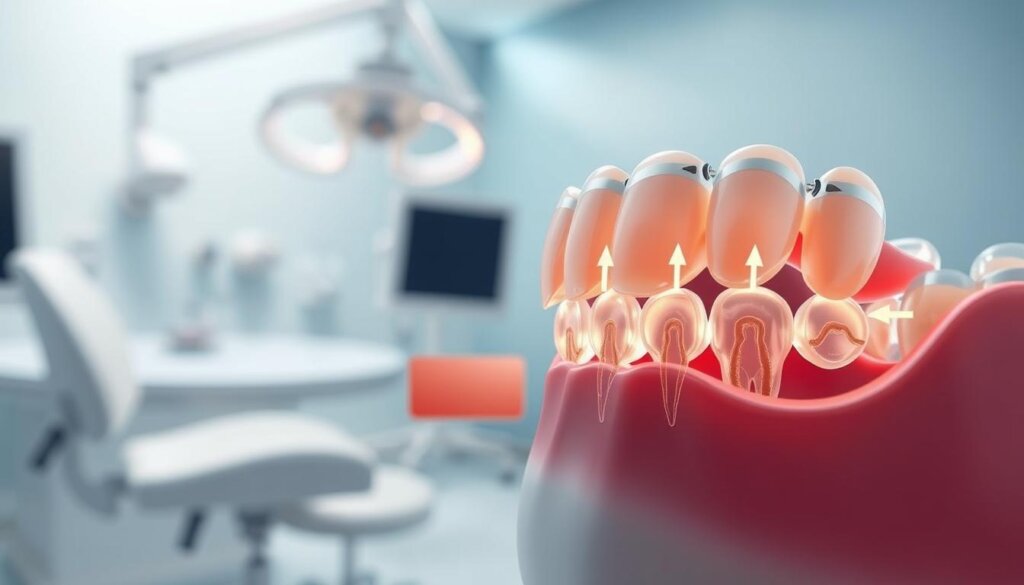
The balance between bone resorption and formation is a key part of orthodontic biomechanics. Several factors influence this process:
- Cellular signaling: Growth factors and cytokines coordinate osteoclast and osteoblast activities
- Blood supply: Adequate circulation delivers nutrients and removes waste products from remodeling sites
- Tissue adaptation: The periodontal ligament stretches and reorganizes to accommodate tooth displacement
- Inflammatory response: Controlled inflammation initiates the remodeling cascade without causing tissue damage
This biological dance needs continuous stimulus to keep moving. If aligners are removed for too long, the teeth can move back. This is called relapse.
Research shows that tooth movement biology works best under certain conditions. Cells respond best to consistent, gentle pressure. This is why clear aligner therapy guidelines recommend wearing them for a long time each day and night.
The Role of Pressure in Tooth Movement
The amount and duration of pressure affect treatment success. Studies in orthodontic biomechanics found that forces between 20 and 26 grams work best. This range creates the right environment for bone remodeling.
Forces in this range keep the biological process going without overwhelming the tissue. Higher forces can harm blood vessels and reduce circulation. This can cause discomfort or slow down movement.
The 22-hour daily wear is more than a recommendation. It’s a biological necessity for how cells react to pressure. Continuous light forces keep the movement going.
| Force Characteristic | Optimal Application | Result |
|---|---|---|
| Continuous pressure | 22 hours per day | Steady bone remodeling and predictable movement |
| Intermittent pressure | Less than 20 hours per day | Partial tissue recovery and possible relapse |
| Light forces (20-26g) | Custom-calibrated aligners | Efficient movement with minimal discomfort |
| Heavy forces (over 50g) | Improperly designed systems | Root resorption risk and tissue damage |
Wearing aligners for less than recommended can cause problems. The biological process starts to reverse. Osteoclast activity decreases, and osteoblast activity slows.
This lets the periodontal ligament recover. The tooth may move back, needing the same aligner to apply forces again. This makes treatment longer and can affect results.
Recent research in tooth movement biology highlights the importance of force consistency. Aligners that apply continuous gentle pressure work better. They cause less discomfort, reduce root resorption risk, and lead to better results when worn as recommended.
The science shows that clear aligner therapy guidelines must consider these biological facts. The 22-hour daily wear is based on our understanding of cellular mechanics and tissue adaptation. Not following this schedule can disrupt the balance needed for successful tooth movement.
Strategies for Increasing Compliance
Improving patient adherence to aligner treatment is key. Using proactive strategies instead of just fixing problems as they happen helps a lot. This way, patients stay on track with their treatment.
Behavioral psychology shows that reminders and tracking help a lot. These methods tackle common issues like forgetting to wear aligners. By using technology and support, patients can stick to their treatment plan better.
Implementing Reminder and Alarm Systems
Reminders are a top way to stop forgetting to wear aligners. Smartphones can send reminders at the right times, like after meals. This helps patients remember to put their aligners back on.
There are even more ways to remind patients, like smart home devices and visual cues. These reminders help patients remember to wear their aligners all the time.

Some reminders get more frequent when patients are at risk of forgetting. This helps prevent non-compliance. Also, carrying an aligner case helps keep them safe and clean.
Using timers helps patients keep track of time without aligners. This makes them more aware of how long they’ve been without them. It’s very helpful during meals or when they’re out with friends.
Leveraging Digital Tracking Applications
Tracking apps make following treatment plans fun and interactive. They track wear time, take photos, and show progress. This helps patients see how well they’re doing.
Many aligner makers have their own apps. These apps let doctors check in on patients’ progress. They also have games to keep patients motivated.
There are also apps for tracking wear time manually. Patients can take photos to show how their teeth are changing. This helps them see their progress and stay motivated.
Looking at tracking data helps patients understand their habits. They can see when they’re not following their plan. This lets them find ways to stay on track better.
Building Accountability Through Community Support
Being part of a support group helps a lot. Patients share experiences and help each other. This makes it easier to stay on track with treatment.
Having a buddy to stay accountable is very helpful. They can check in and celebrate progress together. This keeps patients motivated and on track.
Online forums are also great for support. They offer advice and reassurance. Patients can share their experiences and learn from others.
Professional groups offer expert advice and support. They help patients talk about their treatment and get answers. This support helps patients stay on track with their treatment.
Using reminders, tracking apps, and support groups makes treatment easier. These efforts help patients stay on track and reach their goals on time.
The Psychological Aspect of Wearing Aligners
Clear aligner therapy is more than just technical skills and advanced materials. It also needs patients to be mentally disciplined and motivated. The ease of removable orthodontics brings a unique challenge. Every day, patients must make the conscious choice to stick to their treatment plan.
Unlike fixed appliances, clear aligners require patients to actively participate in their treatment. This makes orthodontic treatment a partnership, not just a clinical process. The mental side of this partnership greatly affects the outcome.
Studies show that aligner treatment compliance is linked to mental attitudes. Patients who understand the mental commitment needed have better success rates. This understanding helps set realistic goals and prepares for the mental effort required.
During treatment, several psychological barriers can arise. These include feeling tired of treatment, social anxiety about removing aligners, and prioritizing comfort over long-term goals. Recognizing these challenges helps patients find ways to overcome them.
Understanding the Mental Commitment
The mental commitment for successful aligner therapy goes beyond simple willpower. It involves several psychological aspects that support consistent behavior. Self-discipline is key, helping patients stick to their schedule even when motivation is low.
Delayed gratification is also important for patient motivation. This skill helps patients choose future benefits over immediate comfort. They must keep their treatment goals in mind when tempted to remove aligners for too long.
Habit formation is another critical aspect. At first, remembering to wear aligners takes effort. But with time, it becomes automatic, requiring less mental energy.
When patients start seeing themselves as committed to treatment, it changes their mindset. This shift makes wearing aligners feel like a natural part of who they are. Studies show that patients who integrate treatment into their self-concept have higher compliance rates.
Intrinsic motivation, or the drive to pursue treatment for personal satisfaction, is very powerful. Patients who connect their treatment to deeper values about self-care and personal growth stay consistent, even when it’s hard.
Building a Positive Mindset Towards Treatment
To support consistent compliance, patients need strategies based on health psychology. Visualization techniques help keep treatment goals in focus. Patients who imagine their completed smile stay motivated to wear aligners every day.
Cognitive restructuring helps patients see the benefits of aligner therapy. This mental shift turns minor inconveniences into reminders of their commitment. Instead of seeing aligner removal as annoying, patients view it as a step towards their goal.
Documenting progress with photos provides tangible evidence of improvement. Seeing how teeth move helps patients stay motivated during long treatments. This visual feedback strengthens the connection between daily efforts and long-term goals.
Celebrating treatment milestones keeps patients excited and motivated. Celebrating progress, like when switching to new aligners, creates positive feelings about treatment. These celebrations reinforce the rewards of sticking to the treatment plan.
| Psychological Factor | Impact on Compliance | Evidence-Based Support Strategy | Implementation Frequency |
|---|---|---|---|
| Intrinsic Motivation | Sustains long-term adherence through internal drive | Connect treatment to personal values and life goals | Initial consultation and quarterly reviews |
| Habit Formation | Reduces mental effort required for consistent wear | Establish routine insertion times tied to daily activities | Daily reinforcement for first 8 weeks |
| Delayed Gratification | Enables choosing future benefits over present comfort | Regular visualization of completed treatment results | Weekly practice sessions |
| Progress Awareness | Provides evidence that effort produces results | Serial photography documenting tooth movement | Every 4-6 weeks during appointments |

Mindfulness practices help patients stay aware of their aligner wear status. This reduces the chance of forgetting to wear them. Mindfulness meditation also lowers stress and anxiety, helping patients stay on track.
Support systems are key to maintaining a positive mindset during treatment. Sharing experiences with others creates accountability and encouragement. These connections remind patients they are not alone.
Setting realistic expectations from the start prevents discouragement. Understanding that tooth movement is gradual helps patients appreciate small changes. This realistic view helps avoid the psychological barriers that come from unrealistic expectations.
By focusing on the mental side of compliance, patients gain tools to support their treatment. This approach recognizes that successful aligner treatment compliance needs both external systems and internal mental frameworks working together.
Alternatives to Clear Aligners
There are other ways to straighten teeth if clear aligners don’t work for you. Clear aligners are great because they’re easy to wear and look good. But, they need you to wear them all the time to work well.
Fixed orthodontic appliances don’t need you to wear them all the time. This makes them good for some people. We look at these options to help you choose the best one for you.
When picking an orthodontic treatment, many things matter. How complex the treatment is, how old you are, and your lifestyle are all important. We compare these options to find the best one for you.
Traditional Braces vs. Clear Aligners
Braces and clear aligners work in different ways. Braces are fixed to your teeth and work all the time. Clear aligners are removable and need you to wear them a lot.
Braces are good for some people because they work all the time. They’re great for fixing complex teeth problems. But, they’re not as invisible as clear aligners.
Clear aligners are better for some because they’re easy to wear and look good. They’re easy to clean and don’t get in the way of eating. But, they need you to wear them a lot to work.
Clear aligners are better in some ways. They’re almost invisible, making them great for people who care about looks. They’re also easy to clean and don’t get in the way of eating.
Here’s a comparison of braces and clear aligners:
| Treatment Factor | Traditional Braces | Clear Aligners | Clinical Significance |
|---|---|---|---|
| Compliance Requirement | None required | High (20-22 hours daily) | Fixed appliances eliminate adherence variable |
| Complex Cases | Highly effective | Limited effectiveness | Severe malocclusions favor fixed systems |
| Esthetic Appearance | Highly visible | Nearly invisible | Clear aligners provide discretion advantage |
| Oral Hygiene | Challenging with brackets | Simplified removal for cleaning | Removable design facilitates maintenance |
How long treatment takes depends on the case and the patient. Clear aligners work fast if you wear them all the time. But, braces can fix complex problems faster because they work all the time.
Choosing between braces and clear aligners depends on many things. It’s important to talk to an orthodontist to find the best option for you. If you think you might not wear clear aligners enough, braces might be a better choice.
Hybrid Solutions: Combining Treatments
Hybrid treatments mix different orthodontic options to get the best results. This approach is based on the latest research and focuses on each patient’s needs. It can make treatment shorter and more effective.
Here are some examples of hybrid treatments:
- Sequential fixed-to-removable therapy: First, braces fix the big problems. Then, clear aligners do the fine details. This way, you get the best of both worlds.
- Temporary anchorage devices with aligners: Small screws in your jaw help aligners work better. This makes it easier to fix teeth that are hard to move.
- Fixed lingual retainers with aligner therapy: If you’ve had braces before and your teeth moved back, this is for you. It keeps your teeth in place while fixing other problems.
- Accelerated orthodontics techniques: These methods make your teeth move faster. This means you don’t have to wear aligners as long, which is easier for some people.
- Partial fixed appliances with selective aligner use: This uses braces on some teeth and aligners on others. It’s good for fixing specific problems while keeping your teeth looking good.
Hybrid treatments show that you don’t have to choose between braces and clear aligners. They can work together to fix your teeth better. This is because different teeth need different treatments.
Hybrid treatments also consider how you feel. If you’re worried about wearing aligners, braces can help with the hard parts. But, if you want your teeth to look good, aligners are better.
Talking to an experienced orthodontist is key. They can help you find the right hybrid treatment for you. This approach is flexible and focuses on what’s best for you.
Maintenance and Care of Aligners
Keeping aligners clean is key to successful orthodontic treatment. The state of aligners affects comfort, oral health, and how well patients stick to their treatment plan. If aligners get dirty, smell bad, or show debris, it can make patients less likely to wear them as directed.
Good care goes beyond just rinsing them now and then. It means setting up a routine for cleaning aligners that fits into your daily life. This routine helps prevent bacteria, keeps them looking clear, and makes wearing them more comfortable. It also helps keep patients happy with their treatment, which is important for success.
Effective Cleaning Methods
Learning the right way to clean aligners is the first step in taking care of them. There are several methods backed by science, each with its own benefits for keeping aligners clean.
Gentle brushing with a soft-bristled toothbrush is the main cleaning method for most people. Use clear, unscented antibacterial soap instead of toothpaste to avoid scratches. This method gets rid of food and saliva effectively after each time you take them out.
Soaking aligners is another way to fight bacteria. Use special cleaning solutions or diluted hydrogen peroxide to kill bacteria that brushing can’t. Ultrasonic cleaning devices use vibrations to remove debris and bacteria, giving a deeper clean.
When and how often you clean your aligners matters. Clean them every time you take them out and before putting them back in. This stops them from getting dirty and smelling bad.
| Cleaning Method | Frequency | Primary Benefits | Implementation Notes |
|---|---|---|---|
| Soft-bristle brushing with antibacterial soap | Every removal (minimum 3x daily) | Removes surface debris and protein deposits | Avoid toothpaste to prevent scratching |
| Soaking in specialized solution | Once daily (15-30 minutes) | Eliminates bacterial biofilm formation | Follow manufacturer dilution instructions |
| Diluted hydrogen peroxide soak | 2-3 times weekly | Deep disinfection and whitening | Use 1:1 ratio with water, rinse thoroughly |
| Ultrasonic cleaning device | Daily or as needed | Professional-grade bacterial removal | Combine with cleaning solution for optimal results |
Stain and Odor Prevention Strategies
To keep aligners looking good, you need to prevent stains and bad smells. These steps help keep them clear and make patients feel more confident and comfortable while wearing them.
Dietary modifications can help avoid stains. Take out your aligners before drinking dark drinks like coffee, tea, and red wine. If you can’t remove them, drink through a straw and rinse right away to reduce staining.
Storing aligners properly during meals helps keep them clean. Use a ventilated case to prevent germs and let them dry out. This also helps prevent losing or damaging them during meals.
Good care of aligners boosts confidence and makes wearing them easier. On the other hand, dirty or smelly aligners can make patients feel self-conscious and less likely to wear them as directed.
Putting aligners back in right after meals helps keep them clean. Leaving them out for too long lets plaque build up, which can make them smell bad and need more cleaning.
Replacing aligners as scheduled keeps them looking and working well. Even with good care, aligners will start to wear out over time. Getting new ones keeps them looking good and working right for moving teeth.
Learning how to take care of aligners is key to success. It’s not just about keeping them clean; it’s also about feeling good about wearing them every day.
Real Patient Experiences
Learning from others who faced treatment setbacks helps new patients avoid similar issues. People who struggled with aligner wear show the real effects of not following the plan. Their stories help bridge the gap between what doctors say and what really happens.
Many patients didn’t realize how hard it would be to stick to the treatment plan. Life changes often got in the way, making it hard to keep up with the routine. Hearing about these experiences helps show why it’s so important to wear aligners as directed.
Testimonials from Patients Who Struggled with Compliance
Many cases show how not wearing aligners enough can cause big problems. For example, one person removed hers for hours each day. This led to eight months of extra treatment time and extra aligners.
This extra time and cost added up, making the whole process more stressful. It also made her feel less confident at work, which was really tough.
“I thought taking off my aligners for meetings wouldn’t be a big deal. But those few hours added up to months of delay. If I could do it again, I’d treat my treatment schedule as seriously as my work.”
Another case involved a college student who wore his aligners less as time went on. He started off good but then wore them less during social times. This made his teeth move back, requiring a whole new treatment plan.
The results were:
- His treatment time went from twelve months to twenty-two months
- He had to spend over $2,200 on a new plan
- He felt really upset about his teeth moving back
- It made him feel less confident during job interviews
A working mom’s story shows how life changes can make it hard to stick to the treatment plan. When she moved, she didn’t wear her aligners as much for six weeks. This made her teeth move back a lot.
Her orthodontist said her teeth moved back about 40%. Getting new aligners took three months. She learned that not wearing them as directed can cause big problems.
“Moving to a new city messed up all my routines. I didn’t realize how fast my teeth could move back. Seeing my teeth move back was really disappointing, and it was something I could have prevented.”
Looking at these cases, we see patterns. People often start off good but then get lazy. Feeling self-conscious about their teeth is a big reason for this.
People often think they wear their aligners more than they really do. This misunderstanding can lead to not wearing them enough, which can hurt the treatment.
Learning from Others’ Mistakes
By studying why people don’t stick to their treatment, we can find ways to prevent it. Getting tired of treatment is a big problem, but there are ways to stay motivated. Celebrating small victories can help.
Life changes can make it hard to stick to the treatment plan. Career changes, moving, and health issues can all make it tough. Knowing these risks can help plan ahead.
Here are some ways to stay on track:
- Tell your orthodontist about any big changes before they happen
- Use reminders to help you remember to wear your aligners
- See your dentist more often during busy times
- Have someone to hold you accountable
- Keep your aligners in different places when you move
Many people underestimate how hard it is to remember to wear their aligners. It takes time and effort to make it a habit. Setting reminders and linking it to daily routines can help.
| Compliance Risk Factor | Typical Consequence | Preventive Strategy | Success Rate |
|---|---|---|---|
| Extended work meetings | 3-6 month treatment delays | Pre-meeting insertion reminder system | 82% improvement |
| Social self-consciousness | 40-60% wear time reduction | Gradual confidence building exercises | 71% improvement |
| Treatment fatigue (>12 months) | Progressive compliance decline | Milestone celebration protocol | 78% improvement |
| Life transition periods | Complete treatment disruption | Proactive orthodontist communication | 85% improvement |
Feeling self-conscious about wearing aligners can lead to wearing them less. People often remove them for big events. This can make treatment take longer.
Successful patients see wearing aligners as a sign of self-improvement. This mindset helps them feel less anxious and wear them more consistently.
Starting off strong is key to success. If you struggle to make wearing aligners a habit early on, it can be hard to keep it up. Orthodontists now focus more on helping during the first few weeks.
Learning from others can really help. Patients who understand the challenges before starting do better. This education is more effective than trying to fix problems after they happen.
Knowing that others have struggled makes it easier to stay on track. Success comes from making consistent choices every day. It’s about being aware of your wear patterns and making adjustments when needed, not expecting to do it perfectly all the time.
Conclusion: Embracing Your Treatment Plan
Clear aligners are a top choice for straightening teeth. They work well when you stick to the plan. Getting a new smile takes effort, but it’s worth it.
The Importance of Staying Committed
Wearing Invisalign for 20-22 hours a day is key to success. It’s based on how teeth move, not just rules. Choosing to wear them every day shows you care about your health.
Staying on track with Invisalign can be tough. You might have to adjust your schedule for work, social events, and more. Seeing it as a way to take care of yourself can make it easier. Studies show this approach helps you stick with it.
Long-Term Benefits of Consistent Wear
Getting your teeth straight does more than just look good. It also helps keep your mouth healthy. You’re less likely to get gum disease and your teeth won’t wear down too fast.
Feeling more confident is another big plus. It can help you in your career and personal life. The hard work of treatment is worth it for the lasting benefits to your health and happiness.

