
What Happens During an Ultherapy Appointment, Step by Step
Plan on about an hour to an hour and a half in the chair if you’re having the full face and neck done, and less for a single area like the brow. The short version of what happens: your skin is cleaned and marked, the provider looks at an ultrasound image of the tissue under your skin, and then a handpiece delivers rows of focused heat at a few different depths. It’s uncomfortable in bursts, it’s over when it’s over, and most people go back to work afterward.
If you’ve booked Ultherapy at our Upper East Side practice, or you’re still deciding, here’s the Ultherapy appointment step by step, from the night before to the ride home.
Before you arrive
Not much to do, honestly. Come with clean skin if you can, or expect makeup to be removed on arrival. Your provider may suggest an over-the-counter pain reliever about an hour ahead if it’s safe for you. Ask first, especially if you take blood thinners. Some practices offer stronger medication, and in that case you’ll need someone to take you home.
Treating the neck or chest? Wear something with an open neckline. And eat. A bagel from the deli on Lexington beats arriving on an empty stomach.
Mention anything already in the treatment area: filler, threads, a recent laser session, a rash that won’t quit. And think about timing. Bruising is uncommon, but if there’s a wedding, a big presentation or a beach trip coming up, book at least two weeks ahead so a stray welt has time to fade.
Step one: photos, history and a plan
First there’s some talking. Your provider goes over your health history and medications, asks what you’d like to change, and takes photos under consistent lighting so there’s something honest to compare against in three months. People tend to describe the same handful of things here, like a brow that seems to have dropped since their late thirties, softness under the chin, or a jawline that looks blurrier in profile than it used to.
Mapping comes next, and it’s less high-tech than you’d expect. After cleaning your skin, the provider draws on you, either with a printed template or as a grid of little dots, to plan where each row of energy goes and which spots to leave alone, such as the area right around the eyes.
This is also when you should hear whether you’re a good candidate at all. Ultherapy suits mild to moderate laxity. Heavy sagging is usually better served by a surgical consult, and a good provider will say so before the gel comes out.
Step two: seeing beneath the skin
Then the cold part: a thin layer of ultrasound gel, and the handpiece pressed flat against your face. Before anything is delivered, the screen shows a grayscale image of what’s underneath, down to the deep supporting layer that surgeons tighten during a facelift. The provider uses that picture to check that the handpiece is in full contact, sitting at the right depth, with no bone right in the path.
That live picture is the main thing separating Ultherapy from a lot of generic HIFU machines, which deliver energy without showing the operator anything at all.
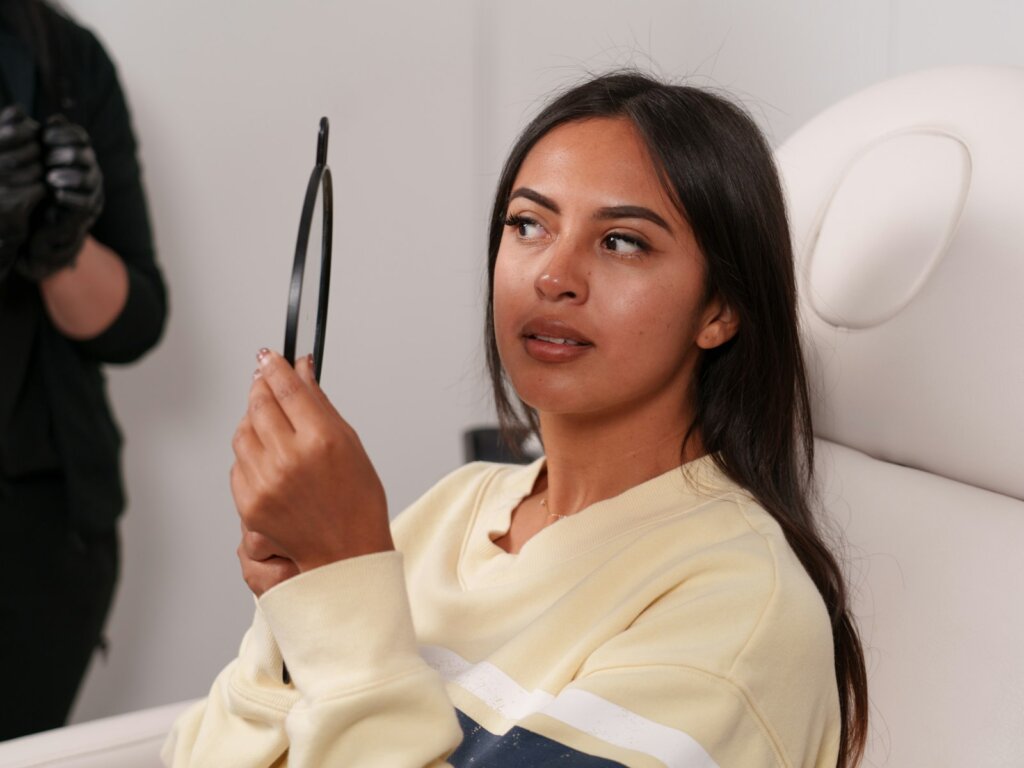
Step three: the treatment lines
When the provider presses the button, you’ll feel a row of tiny hot points under the skin, warm and prickly, sometimes more of a deep ache, for a second or two before they slide the handpiece over and do the next one. Over bone (the jawline, the forehead) it tends to be sharper, and over the softer cheeks it’s usually milder. You’re allowed to ask for a break, and the energy can be dialed down if you need it.
It’s easier when you know what’s coming, so the better providers talk you through it (“three more along the jaw, these are the spicy ones”). Some patients bring earbuds and a podcast. For others it’s a death grip on the armrest, and that’s fine too.
Different transducers reach different depths, commonly around 4.5, 3.0 and 1.5 millimeters, and many treatments use more than one. The number of lines and their direction are planned for your face, an approach described in published work on customized vectoring with micro-focused ultrasound with visualization. A full face and neck adds up to several hundred lines, which is why it takes an hour or more.
Step four: right after treatment
The gel and marks are wiped away. You may look pink for an hour or so, and some people get mild swelling, tingling or tenderness that lasts a few days to a couple of weeks. Occasional bruising or faint welts along the lines can appear and fade. If one spot is sore, ten minutes with an ice pack (not straight on the skin) is fine. Makeup is generally fine the same day, and most people head straight back to the office or out to lunch on Park Avenue.
We’ve written separately about the days after, with a day-by-day guide to Ultherapy aftercare and a list of what to avoid after Ultherapy, so we won’t repeat all of it here.
When you’ll see results
Looking in the mirror that evening won’t tell you much. What the ultrasound does is start a slow collagen response, so while a few people think they see something early, the actual lift usually builds over two to three months and can keep improving for up to six. A lot of practices schedule a follow-up with photos around the three-month point. Most people only need the one treatment, and whether you ever repeat it depends on how your skin keeps aging.
Take your own photos too. Same window, same light, same angle, once a month. Change that builds slowly is easy to miss in the bathroom mirror you look into every morning.
Frequently asked questions
Does Ultherapy hurt?
It’s uncomfortable in short bursts, mostly over bone. A pain reliever beforehand and adjustments to the energy level help, and the sensation stops when the pulses stop.
Can I go back to work the same day?
Yes, for most people. There’s no wound to look after, though you may look a little flushed for an hour or so.
How long should I block out for the whole visit?
Plan on roughly two hours door to door for a full face and neck, including photos, mapping and cleanup. A brow-only treatment is shorter.
Book Ultherapy on the Upper East Side
Ultherapy at VisoDent NY is done at 903 Park Ave, New York, NY 10075, on the Upper East Side, and because we book one patient at a time, you won’t be sharing the waiting room. Call 212-991-9095 to set up a consultation or just to ask a question first.


