Veneers vs. Crowns: What’s the Difference?
A veneer is a thin shell that’s bonded to the front of a tooth. A crown is a cap that goes all the way around and over the top of the tooth. Veneers are primarily used to alter the appearance of a healthy front tooth, whereas crowns are used to rebuild and protect a tooth that’s cracked, heavily filled or otherwise weakened.
Both can be made of porcelain, and from across the dinner table they can look exactly the same. The difference is down in the tooth. If you’re looking at porcelain veneers at our Upper East Side practice versus a porcelain or zirconium crown, the state of the tooth will usually make the call.
How much of the tooth does each one cover?
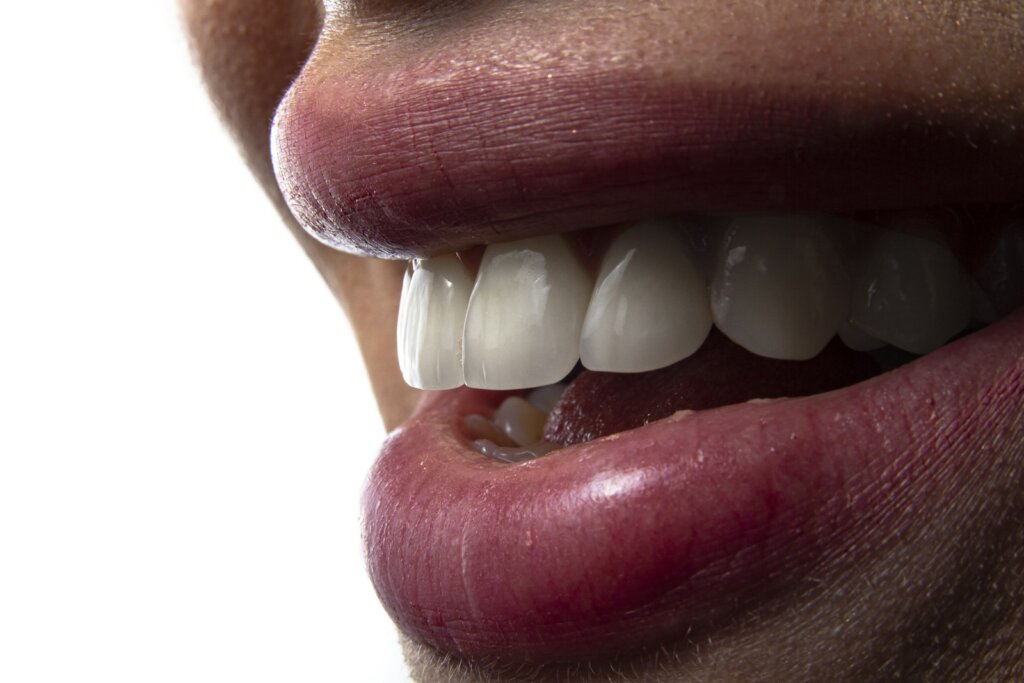
Picture a front tooth from the side. A veneer is only on the face of the tooth (the bit you see when you smile) and often just barely covers the biting edge. The back of the tooth (the side your tongue comes into contact with) is all natural enamel.
A crown is a full jacket. It covers the front, the back, the sides and the chewing surface and terminates at or just below the gum line. That’s why they’re the go-to for the molars, as those are the teeth that take the brunt of the force when you’re working through a steak or a stale everything bagel, and a thin front-only shell wouldn’t be anywhere near adequate.
How much tooth has to be removed?
This is the bit people are most concerned about and the difference is massive. A standard porcelain veneer will require somewhere in the region of 0.5 mm of enamel to be removed from the front surface (sometimes less), and a number of the no-prep cases will require virtually none at all. A crown, on the other hand, requires space on all sides so that the material is thick enough to withstand the forces of chewing, and that generally means removing 1 to 2 mm all the way around.
Researchers have measured it. A frequently quoted 2002 study in the Journal of Prosthetic Dentistry estimated that full-crown preparations on front teeth removed somewhere between 60 and 70% of the visible tooth structure, as opposed to 3 to 30% for veneers (the latter figure varying according to the design). Once enamel is removed, it doesn’t grow back, so a careful dentist will opt for the most conservative approach that will in fact work.
When is a veneer the better choice?
Veneers are for teeth that are essentially sound, just not looking the way you want. You’re looking at a tooth that’s stubbornly gray or yellow (tetracycline staining is the classic example), a small chip from a water bottle incident on the M15, worn or uneven edges, a slightly short or narrow tooth, or small gaps. The key thing is that there has to be plenty of enamel left to bond to, as the strength of the veneer comes from that bond.
For a single little chip, a veneer may be more than you need. Composite bonding can fix it in one visit with no drilling at all, and our comparison of veneers vs. bonding looks at when each one is the right solution.
When does a tooth need a crown instead?
When it’s a structural problem. A big old filling which now forms the bulk of the tooth, a crack through a molar, a back tooth that’s had a root canal (they tend to become brittle and split without full coverage), a break that’s taken off a corner and part of the side. Crowns can also be placed on top of dental implants and used to anchor bridges.
It can sometimes be a matter of judgment. A broken front tooth may be dealt with by bonding, a veneer or a crown, depending on how much is missing and where the break is. We go through that decision in how a dentist chooses between bonding, a veneer or a crown for a broken tooth. Heavy grinding is also a factor. If you’ve already got your teeth worn down quite flat, you may well need crowns on the back teeth even if the front teeth only require veneers.
Lifespan and cost: how do they compare?
Closer than most people realize. Well-made porcelain veneers and crowns will both commonly last 10 to 15 years (often much longer). The things that will shorten their life are the same as always: night grinding, chewing ice or pens, gum recession and new decay at the margin where the restoration meets the tooth. A night guard and regular cleanings will both help.
Per tooth, the fees are generally in the same ballpark in Manhattan (often somewhere in the $1,500 to $3,000+ range) and will vary quite considerably depending on the material, the lab and how many teeth you’re doing. Insurance is another matter. Most dental plans will treat a crown placed on a damaged tooth as restorative and will therefore pay a portion of it. Veneers placed for purely aesthetic reasons are generally considered to be cosmetic and not covered. Always check your own plan before you jump to any conclusions; your consultation will give you the exact figure.
Can you mix the two? Yes, you can, and it’s done all the time. One front tooth with a root canal might end up with a crown while the others in the row get veneers, all from the same matching porcelain, so the row looks like one set. Getting that match right is a fussy bit of lab work, which is why it’s worth seeing some photos of the dentist’s previous cases.
For a neutral explanation of what crowns are and when they’re used, the American Dental Association’s page on crowns is definitely worth a read before your visit.
Frequently asked questions
Is a veneer or a crown stronger?
A crown, as it surrounds the whole tooth. A veneer is quite strong enough for a healthy front tooth, but it’s not really designed to hold a cracked tooth or a tooth with a lot of filling material together.
Can a veneer be put on a back tooth?
Very rarely. The back teeth take the brunt of the chewing forces and generally don’t show when you’re smiling, so if they need any work it’s normally just a filling, an onlay or a crown.
Can you replace a veneer with a crown later?
Usually, yes. If a veneered tooth should subsequently crack or need a root canal, it can often be prepared for a crown. The reverse though (from crown back to veneer) isn’t possible as the tooth structure has already been removed.
Not sure which one you need?
At VisoDent NY, we look at the tooth, your bite and your gums before recommending a veneer or a crown, and we’ll tell you why. Visit us at 903 Park Ave, New York, NY 10075 (Upper East Side), or call 212-991-9095 to schedule a consultation.