How Long Does a Dental Crown Last?
A dental crown will usually last somewhere between 10 and 15 years, and it’s not uncommon to see one go on for 20 years or more. Where yours will fall is going to be less to do with the crown itself and more to do with the tooth underneath it, the gumline and how hard you bite down at 3 a.m.
That last bit is what surprises people. A good crown doesn’t wear out like a tire. What usually ends its run is decay at the edge, gum recession, a crack in the tooth underneath or porcelain that’s chipped from clenching. If you’re thinking about porcelain or zirconia crowns at our Upper East Side practice, those are the things you need to be aware of, as you can in fact influence quite a bit of it.
What does a crown’s life look like over the years?
The first few weeks are an adjustment period. A new crown can feel slightly tall when you bite, and a quick adjustment usually fixes it; leaving a high spot alone is a bad idea, because that one tooth then takes a beating with every meal. After that, most crowns settle into a long, uneventful middle stretch, and the years from about two to eight tend to be quiet if you floss and keep your checkups.
Past the ten-year mark, things around the crown start to change even if the crown itself hasn’t. Gums thin out with age and with years of enthusiastic brushing. The bite shifts a little as other teeth wear or drift. The cement line at the edge, which on a well-made crown is thinner than a human hair, has spent a decade bathed in coffee, seltzer and whatever else you sip on the walk to work. None of that means a crown has failed at year twelve, but it does mean the exam and the X-rays start to matter more.
Does the material change how long a crown lasts?
Somewhat. Gold is the longevity champion. Full-gold crowns can go 25 years or more because the metal bends very slightly under load rather than cracking, and it wears at about the same rate as enamel, so it doesn’t grind down the tooth it bites against. Very few people want one on a front tooth, though.
Porcelain fused to metal (PFM) crowns have decades of data behind them, and their usual complaints are a chip in the porcelain or a gray rim of metal at the gum after recession. Solid zirconia is extremely hard to break, which makes it a sensible choice for a molar in someone who clenches, while zirconia with porcelain layered on top looks more natural but can chip in that outer layer. Lithium disilicate, the material behind IPS e.max, is a glass-ceramic that looks lovely on front teeth and holds up well when it’s bonded properly. In practice the choice depends on the tooth, the bite and how much of it shows when you smile.
Why do crowns fail?
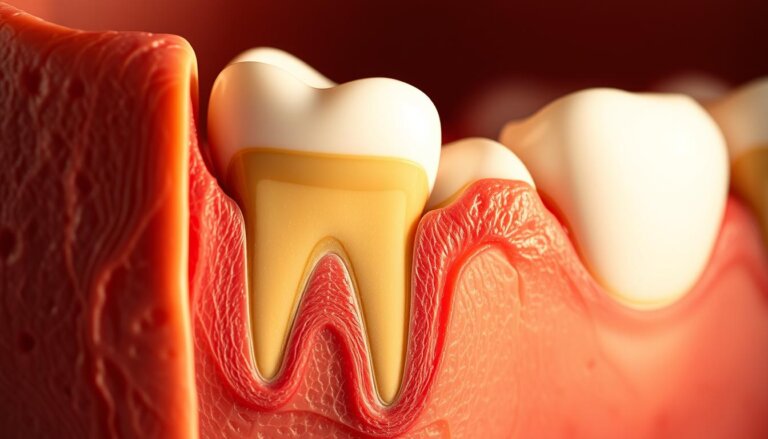
Mostly at the margin. The margin, where the porcelain meets the tooth at or just below the gum line, is a very small ledge, and plaque absolutely loves that. Crowns themselves can’t decay, but the tooth they’re bonded to can, and a cavity can start at the margin and go underneath quite quickly. That’s one of the most common reasons for a crown to be replaced, and it’s largely preventable with floss.
Clenching is the other big one. During sleep some people bite down with several times the force of normal chewing, for minutes at a stretch, night after night, which can chip porcelain, break down the cement seal and sometimes crack the tooth under the crown. The nerve can play a part too, because teeth that need crowns usually had big fillings or cracks first, and some of them go on to need a root canal years later. If a crack is what’s sending you toward a crown now, our article on whether a cracked tooth needs a crown or just a filling explains how that call gets made.
How can you tell a crown needs replacing?
Your floss is often the first to know. If it frays or catches at the same crown every night, the margin may have opened or a sliver of porcelain may have broken off. A dark line at the gum could be a metal collar peeking out or the start of decay, and there’s no way to tell which in the bathroom mirror. Cold sensitivity on one crowned tooth, a sore spot when you bite into something firm like the crust of a Sicilian slice, or a stale taste that seems to come from one area are all worth a call.
A crown that rocks, suddenly feels high, or comes off entirely needs to be seen soon even if nothing hurts. Keep it in a small container and bring it along, since an intact crown can sometimes be cleaned and recemented. If the tooth itself broke, our guide to what the dentist does when a crowned tooth breaks covers the possibilities.
How do you make a crown last longer?
Floss along the margin every day, angling the floss against each side of the tooth and slipping it just below the gum; a water flosser is a reasonable stand-in if string isn’t going to happen. Fluoride toothpaste helps the exposed tooth at the edge resist decay. If you grind or clench, wear the night guard, since it spreads the force across the whole arch instead of letting it land on one crown. And leave the ice cubes, bottle caps and that stubborn bag of almonds to other tools. The ADA’s patient page on crowns is a neutral primer if you’d like background before a visit.
Frequently asked questions
Can a dental crown last a lifetime?
Some do. A gold crown on a healthy tooth in someone who doesn’t grind may never need replacing. For most people it’s safer to plan on a replacement eventually and enjoy the extra years if it keeps going.
Can a chipped crown be repaired?
Sometimes. A small chip in porcelain can be polished smooth or patched with composite, though the patch won’t be as durable as the original surface. Chips at the edge of the crown usually mean a new one.
Can you get a cavity under a crown?
Yes, and it usually starts at the margin. That’s why the floss and the checkup X-rays matter even when the crown feels perfect.
Have your crowns checked on the Upper East Side
If a crown feels different, or nobody has taken a close look at yours in years, an exam will show whether it’s still sealing well. VisoDent NY is at 903 Park Ave, New York, NY 10075, on the Upper East Side. Call 212-991-9095 to book.